The Department of Energy’s (DOE) Oak Ridge National Laboratory (ORNL) convened scientists, engineers and technology leaders for the 2026 Southeastern Quantum Conference (SQC), bringing together experts from academia, national laboratories, industry and government to advance quantum information science and strengthen collaborations that support U.S. competitiveness.
Technology & Innovation#Oak Ridge National Laboratory#advanced materials#innovation
In partnership with A.J. Tuck Company, scientists at the U.S. Department of Energy’s (DOE) Oak Ridge National Laboratory (ORNL) have developed a new manufacturing approach that could simplify production of critical components for advanced nuclear reactors and other energy and defense applications. The method combines 3D printing and electroforming to produce complex, leak-free hot isostatic pressi
Energy InfrastructureTechnology & InnovationEnergy Policy#Oak Ridge National Laboratory#grid#energy security#advanced materials#innovation#energy policy
The Department of Energy's (DOE) Oak Ridge and Idaho national laboratories announced a collaboration to expand the domestic supply chain of industrial pressure vessels. Together, the labs will help enable wire arc 3D printing of these large components, which are critical for energy-related industries and capable of reliably withstanding harsh service conditions. The initiative boosts the rapid exp
Technology & InnovationEnergy Policy#Oak Ridge National Laboratory#advanced materials#innovation#energy policy
M. Parans Paranthaman, an expert in solid-state chemistry and materials science at the Department of Energy’s (DOE’s) Oak Ridge National Laboratory (ORNL), has been named R&D World’s 2026 Researcher of the Year. The honor recognizes his career translating fundamental materials research into practical technologies with real-world applications.
Technology & Innovation#Oak Ridge National Laboratory#advanced materials#innovation
Internationally renowned radiopharmaceutical scientist Carolyn Anderson is joining the University of Tennessee and the Department of Energy’s Oak Ridge National Laboratory to advance targeted cancer therapies and strengthen Tennessee’s growing leadership in nuclear medicine.
Medical ResearchTechnology & Innovation#Oak Ridge National Laboratory#medical research#clinical research#advanced materials#innovation
Brookhaven National Laboratory and PsiQuantum today announced a collaboration that will leverage PsiQuantum’s software platform “Construct” to support Brookhaven Lab scientists.
Technology & Innovation#Brookhaven National Laboratory#advanced materials#innovation
Researchers will develop an AI model to accelerate electric grid expansion planning with optimal accuracy, affordability, and efficiency in operations.
Energy InfrastructureTechnology & Innovation#Brookhaven National Laboratory#grid#energy security#advanced materials#innovation
Researchers have successfully transmitted light particles containing quantum information through open air between Brookhaven Lab and Stony Brook University.
Space & AstronomyEnergy InfrastructureTechnology & Innovation#Brookhaven National Laboratory#astronomy#astrophysics#grid#energy security#advanced materials#innovation
NSF transformed materials science from isolated research efforts into a powerful scientific enterprise that drives innovation across industry and everyday life
Medical ResearchTechnology & Innovation#U.S. National Science Foundation#Science Matters#medical research#clinical research#advanced materials#innovation
Imagine swimming in open water and feeling slime brush against your leg. Most people might shake it off without a second thought. But what if the surface of a boat could do the same? Researchers from Washington University in St. Louis’ McKelvey School of Engineering are about to find out, thanks to a $750,000 grant from the U.S. Department of Defense to develop materials that incorporate soft robo
Environment & ClimateTechnology & InnovationEngineering#Washington University in St. Louis#Newsroom#climate#decarbonization#advanced materials#innovation
Coalition of research universities dedicated to advancing quantum science
Research NewsTechnology & Innovation#Ohio State University#Campus#staff#Share on: X#More Ohio State News#View all headlines - More Ohio State News#advanced materials#innovation
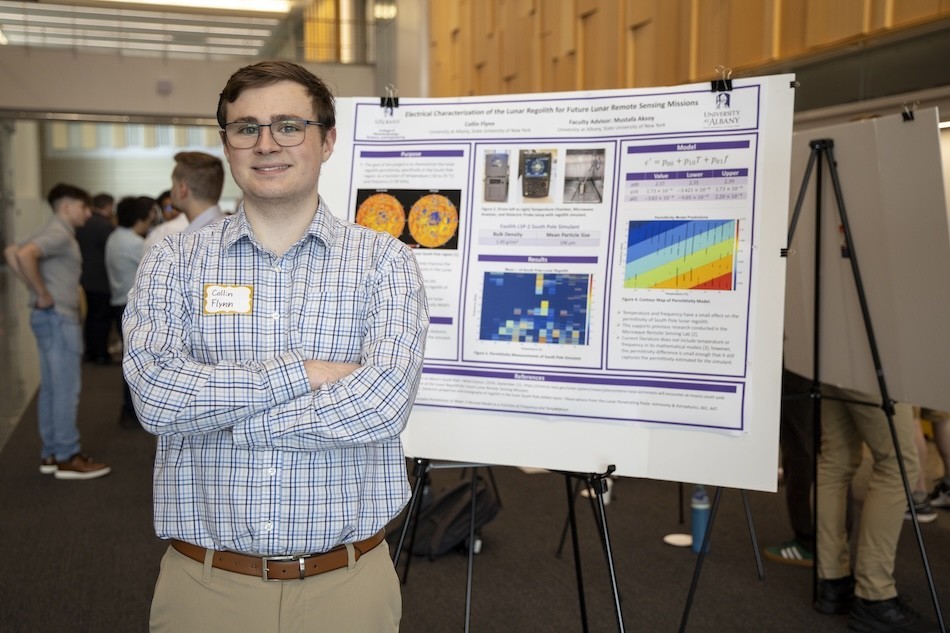
UAlbany sophomore Collin Flynn spent his summer studying the electrical properties of moon soil in support of ongoing efforts to get humans back to the moon, thanks to a 10-week research opportunity provided through the College of Nanotechnology, Science, and Engineering's Summer Undergraduate Research Program.
ResearchEnvironment & ClimateTechnology & Innovation#University at Albany#research#climate#decarbonization#advanced materials#innovation
Until now there was an upper limit to the energy produced by atoms irradiated with laser light. Now UC San Diego researchers have crossed the threshold using helium atoms and intense UV lasers.
ResearchTechnology & Innovation#University of California San Diego#UC San Diego#UCSD Today#advanced materials#innovation
A multidisciplinary team of researchers including computer scientists at UC San Diego has been awarded a $37.5 million grant from the National Science Foundation for a center aimed at designing practical and self-correcting quantum computers from top to bottom,.
ResearchTechnology & Innovation#University of California San Diego#UC San Diego#UCSD Today#advanced materials#innovation
Graphene is an exceptionally useful material for creating batteries, catalysts, and electronic devices. Yet producing graphene typically requires temperatures as high as 900°C, limiting energy efficiency and making structural control difficult. To make graphene production more practical, a recent study has overcome this long-standing temperature barrier. In a study published in the Journal of the
Physicists from the University of Amsterdam have teamed up with colleagues from Zürich to experimentally verify a curious phenomenon that had already been predicted by theory: an atomic-scale effect similar to how a football curves when kicked with spin. The results were published in the journal Physical Review Letters earlier this month.
Technology & Innovation#University of Amsterdam#advanced materials#innovation
Environment & ClimateWashington University in St. Louis
Machine learning doesn’t replace human intelligence, but it can outlast human endurance, which makes it a very helpful tool for chemistry and material discovery. Scientists know the machine learning models can make predictions based on the vast reams of data it is trained on, but can it take it a step further and massively scale up testing out those predictions? “We already see that AI is powerful
Environment & ClimateTechnology & InnovationData & Computer Science#Washington University in St. Louis#Newsroom#climate#decarbonization#advanced materials#innovation
Scientists could have a new way to explore the hidden behaviour of matter, thanks to research involving Queen Mary University of London that uses a quantum computer to carry out a new form of computational spectroscopy. Spectroscopy is an important scientific technique used to understand the properties of matter. By analysing how materials and molecules respond to energy or light, researchers can
Technology & Innovation#Queen Mary University of London#QMUL Latest News#Science And Engineering#advanced materials#innovation














.png)