発表のポイント
- Hyperbolic phonon polariton (Note 1) (HPhP) is a special state created by the combination of light and matter that can confine and propagate the electromagnetic field of infrared light in a space much smaller than its wavelength, and its ultrahigh-speed control is expected to be a cutting-edge technology in nanophotonics (Note 2).
- However, the wavelength of HPhP changes significantly depending on the frequency of the irradiated light, so when femtosecond pulsed lasers (Note 3) containing a wide range of frequency components are used, HPhP of different wavelengths overlap, making it difficult to observe this ultra-fast change in real space.
- In this research, we developed a technology that simultaneously achieves femtosecond/nanometer spatiotemporal resolution and high frequency selectivity using ultrafast infrared near-field optical microscopy (Note 4).
- これにより、ファンデルワールス物質 (注5) である二硫化タングステン (WS2) と六方晶窒化ホウ素 (hBN) を積層したヘテロ構造に可視光パルスを照射し、WS2内に光キャリア (注6) を生成したところ、それに伴って隣接するhBN中を伝搬するHPhPが超高速で変化する様子を直接観測することに成功しました。
- This result is expected to develop into future ultrafast nanophotonics as a new fundamental technology for observing and controlling nanoscale light propagation on the femtosecond time scale.
概要
分子科学研究所の鎌田一輝特別共同利用研究員 (大阪公立大学大学院工学研究科 博士後期課程)、西田純助教(兼 総合研究大学院大学助教)、熊谷崇准教授(兼 総合研究大学院大学准教授)を中心とする研究チームは、hBNとWS2Using a van der Waals heterostructure consisting of WS2By exciting the HPhP with a visible light pulse, we successfully modulated the HPhP propagating in adjacent hBN on a femtosecond time scale and directly visualized its ultrafast changes.
HPhPは、赤外光と物質中の光学フォノン (注7) が強く結びついて形成される状態で、赤外光を通常の光の波長よりもはるかに小さな空間に閉じ込めることができるため、ナノスケールの光制御技術や高感度分光などへの応用に加え、その超高速制御は、将来の超高速ナノ光デバイスの実現に向けた基盤技術として期待されています。
一方、HPhPは光の周波数によって波長が大きく変化する強い分散を示します。そのため、広い周波数成分を含むフェムト秒赤外パルスを用いると、異なる波長のHPhPが同時に励起され、それらの信号が重なって平均化されるため、伝搬の様子を鮮明に観察できないという問題がありました。
Therefore, in this research, we introduced a method in which scattered light is separated using a diffraction grating (Note 8) and then detected using an ultrafast infrared near-field optical microscope. As a result, it has become possible to directly observe the ultrafast control of HPhP while maintaining a high time resolution of approximately 150 femtoseconds.
This new ultrafast nanoimaging technology allows visible light pulses to be2に照射して光キャリアを生成すると、それに伴って隣接するhBN中を伝搬するHPhPの電場振幅が、一時的に変化することを実空間で観測しました。さらに、比較的厚いWS2In the structure consisting of and hBN, we also visualized how the wavelength of HPhP changes.
Numerical simulations show that the observed ultrafast modulation of HPhP is associated with WS due to the generation of photocarriers.2の過渡的な誘電率 (注9) の変化によって説明できることを示しました。本成果は、ナノスケールの光伝搬をフェムト秒の時間スケールで観測・制御する新たな基盤技術として、将来の超高速ナノフォトニクスへの展開が期待されます。
The results of this research were published online in the international academic journal "Nano Letters" on July 27, 2026.
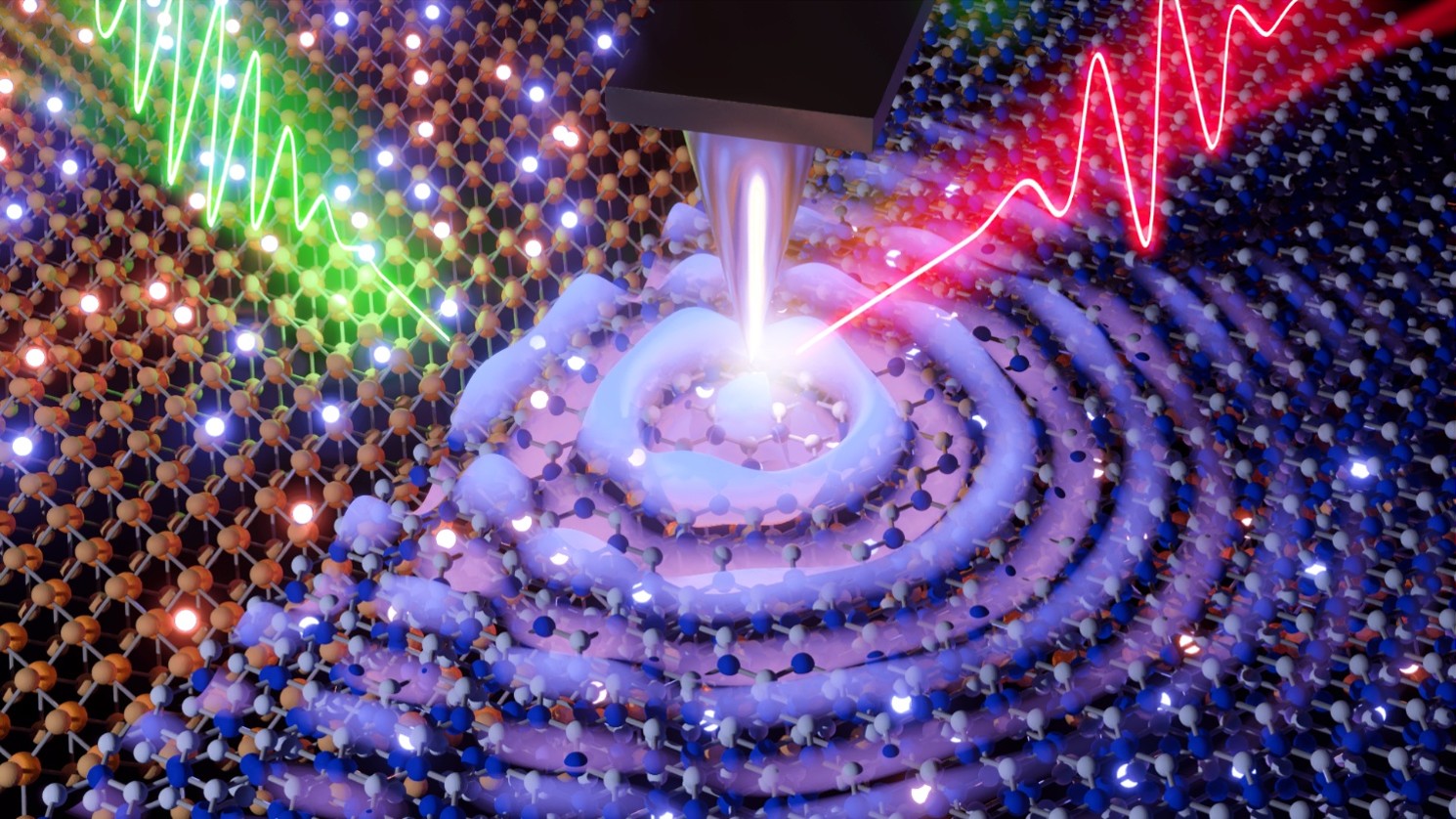
Image diagram of ultra-high-speed nano-imaging of HPhP using ultra-high-speed infrared near-field optical microscopy
Glossary
(Note 1) Hyperbolic phonon polariton (HPhP): A type of polariton (Note 11) that is formed when the electromagnetic field of infrared light and optical phonons, which are collective vibrations of atoms in matter, are strongly coupled, and has the properties of both light and matter. In materials such as hBN, whose dielectric properties vary greatly depending on the crystal orientation, HPhP with a special dispersion called "hyperbolic dispersion" is formed. HPhP can confine and propagate infrared light in a space much smaller than the wavelength of normal light, so it is expected to be applied to nanoscale light control.
(Note 2) Nanophotonics: A research field that uses nanometer (one billionth of a meter) scale structures and materials to control the interaction between light and materials. By confining and controlling light in nanoscale spaces, it is expected to be applied to ultra-small optical devices, highly sensitive sensors, optical information communications, etc.
(Note 3) Femtosecond pulse laser: Femtosecond (fs) is 1/1000 trillionth of a second (10-15This is an extremely short unit of time (seconds). A femtosecond pulse laser is a laser that generates light pulses with extremely short durations, and is used to observe ultrafast phenomena caused by electrons and atoms in materials. In this research, we use optical pulses with a time width of approximately 150 femtoseconds.
(注4) 超高速赤外近接場光顕微鏡:原子間力顕微鏡 (AFM) の金属探針先端に赤外光を照射し、探針先端に生じる近接場光を利用して物質の光学的性質を観察する顕微鏡です。通常の光学顕微鏡の回折限界を超えたナノスケールの空間分解能をもちます。さらにフェムト秒パルスレーザーと組み合わせることで、ナノスケールの超高速光学現象をフェムト秒の時間分解能で追跡できます。
(Note 5) Van der Waals material: A layered material in which atoms within the layers are connected by strong chemical bonds, while the layers are connected by relatively weak van der Waals forces derived from fluctuations in electron distribution and polarization. Because the bond between the layers is weak, it can be peeled off in single or several layers using adhesive tape. It is also possible to stack different types of van der Waals materials to create a heterostructure (a stacked structure that combines different materials).
(注6) 光キャリア:半導体が光を吸収することで生成される、電気を運ぶことのできる電子や正孔 (電子が励起されることにより生じる「電子の空き」) の総称です。光キャリアが生成されると、物質の電気的・光学的性質が一時的に変化します。本研究では、可視光パルスによってWS2内に光キャリアを生成し、それに伴うWS2の誘電率変化を利用して、隣接するhBN中のHPhPを超高速に変調しました。
(Note 7) Optical phonon: The collective vibration of atoms in a crystal expressed as a quantum is called a phonon. Optical phonons are modes in which multiple atoms contained in the basic unit of a crystal vibrate in opposite directions, that is, in antiphase. If this vibration causes electrical polarization, it interacts strongly with the electromagnetic field of infrared light. In hBN, such optical phonons and the electromagnetic field of infrared light combine to form phonon polaritons, of which HPhP shows hyperbolic dispersion.
(注8) 回折格子:表面に細かな溝などの周期構造をもつ光学素子です。光を当てると、波長(周波数)の異なる光がそれぞれ異なる方向へ回折されるため、複数の波長成分を空間的に分けることができます。本研究では、この性質を利用して、探針先端から散乱された広帯域の赤外光の中から、特定の周波数成分だけを選択して検出しました。
(Note 9) Dielectric constant: A physical quantity that represents the polarization of charges (polarization) that occurs when electrons and ions inside a material respond when an electric field is applied to the material. Dielectric constant greatly influences how light travels through a material and how much it is absorbed or reflected. Its value changes depending on the frequency of the light, the orientation of the crystal, the electronic state of the material, etc.
Magazine information
Magazine: Nano Letters
Paper title: Ultrafast Nano-Imaging and Optical Control of Hyperbolic Phonon Polaritons at hBN/WS2 Heterojunctions
著者:Kazuki Kamada, Keisuke Shinokita, Fanyu Zeng, Ryo Kitaura, Kenji Watanabe, Takashi Taniguchi, Alexander Paarmann, Masahiro Shibuta, Takashi Kumagai*, and Jun Nishida* (*責任著者)
DOI:https://doi.org/10.1021/acs.nanolett.6c02448
research team
This research was carried out by a research team led by Kazuki Kamata, Special Joint Researcher at the Institute of Molecular Science, National Institutes of Natural Sciences (Doctoral student, Graduate School of Engineering, Osaka Public University), Assistant Professor Jun Nishida, and Associate Professor Takashi Kumagai.
Co-author
- Associate Professor Keisuke Shinokita (Institute of Molecular Science)
- Researcher Fanyu Zeng(National Institute for Materials Science)
- Ryo Kitaura Group Leader(National Institute for Materials Science)
- 渡邊賢司 特命研究員(National Institute for Materials Science)
- Takashi Taniguchi Director(National Institute for Materials Science)
- Alexander Paarmann グループリーダー(Max Planck Society Fritzhaber Institute)
- Associate Professor Masahiro Shibuta (Visiting Associate Professor, Institute of Molecular Science, Osaka Public University)
Osaka Public University Graduate School of Engineering
Associate Professor Masahiro Shibuta
TEL: 072-247-6162
E-mail: shibuta[at]omu.ac.jp
*Please change [at] to @.
Osaka Public University Public Relations Division
TEL: 06-6967-1834
E-mail:koho-list[at]ml.omu.ac.jp
*Please change [at] to @.
Source: https://www.omu.ac.jp/info/research_news/entry-25611.html