Key points of this research result
- When mice were given HMPA (*2), a metabolite derived from intestinal bacteria of polyphenols (*1) found in coffee and mandarin oranges, it was shown to be effective in preventing kidney disease induced by an adenine diet (*3).
- It has been found that HMPA has the ability to suppress kidney inflammation and functional decline.
- In the future, this may lead to the development of functional foods that help maintain kidney health.
overview
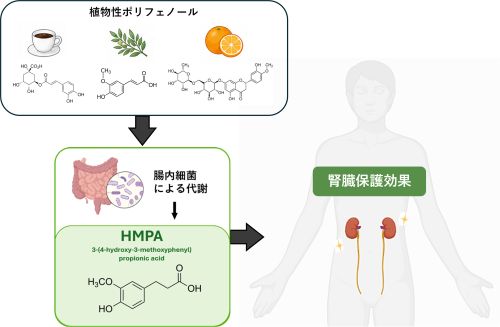
In recent years, the functionality of metabolites produced by intestinal bacteria during the ingestion of food ingredients has attracted attention. Professor Noriyuki Yanaka of the Graduate School of Integrative Life Sciences, Hiroshima University, and a research group at Maruzen Pharmaceutical Co., Ltd. focused on 3-(4-hydroxy-3-methoxyphenyl) propionic acid (HMPA) as a metabolite (*4) of intestinal bacteria after ingesting food ingredients rich in polyphenols. When HMPA was fed to mice with adenine nephritis, it was shown to be effective in preventing nephropathy. HMPA is a metabolite produced by the conversion of chlorogenic acid and hesperidin, which are abundant in plants, by intestinal bacteria, and its functionality has attracted attention. The possibility of using HMPA, an intestinal bacterial metabolite, as a new functional food ingredient (*5) with kidney-protective effects has been demonstrated.
The results of this research were published in the scientific journal "Scientific Reports" on July 1, 2026.
Published paper
Magazine name: Scientific Reports
Paper publication date: July 1st
Title: 3-(4-Hydroxy-3-methoxyphenyl) propionic acid prevents renal fibrosis and inflammation in CKD mice induced by adenine.
Author names: Haruka Osedo, Kurumi Ei, Mikoto Oda, Ayane Kudo, Susumu Yoshino, Takashi Tagawa, Hiroshige Kuwahara, Nobuo Yamaguchi, Siyi Chen, Rahmawati Aisyah, Hidemasa Bono, Thanutchaporn Kumrungsee, Noriyuki Yanaka (corresponding author).
DOI: https://doi.org/10.1038/s41598-026-60395-z
background
Polyphenols are a major target of food functionality research, but the mechanisms underlying their functionality are still largely unknown. In recent years, the functionality of metabolites produced by intestinal bacteria during the ingestion of food ingredients has attracted attention, and 3-(4-hydroxy-3-methoxyphenyl) propionic acid (HMPA) has been reported as an intestinal metabolite after ingesting polyphenol-rich food materials. HMPA is a component produced when intestinal bacteria metabolize chlorogenic acid and hesperidin, which are found in coffee and citrus fruits, and its functionality has attracted attention.
Clinical trials using HMPA have shown a decrease in blood sugar levels and a significant decrease in abdominal visceral fat area after 2 hours of a glucose tolerance test, which is a test that examines changes in blood sugar levels after drinking glucose, demonstrating the usefulness of HMPA, which is a polyphenol-derived intestinal bacterial metabolite, as a functional food ingredient. On the other hand, the number of patients undergoing artificial dialysis after kidney disease worsens has reached 300,000, which has become a serious social problem.However, since kidney disease is a dangerous disease that progresses without any noticeable symptoms in the early stages, there is a strong need for functional foods that can prevent the onset of kidney disease and reduce the severity of nephropathy. We focused on the functionality of HMPA, which is produced by intestinal bacteria after ingesting familiar food components such as polyphenols, and verified its effect on the onset of kidney disease in mice.
Contents of research results
The research team induced nephritis in mice by feeding them an adenine diet, and examined the effect of adding HMPA to the diet on the onset of nephritis. Intake of HMPA significantly suppressed increases in blood urea nitrogen (BUN), which is a marker of renal function, and creatinine concentration (reference material). In mice ingested with HMPA, the expression levels of genes related to tissue fibrosis, such as fibronectin and collagen genes, and genes related to inflammation were significantly reduced in the kidneys. When mice are fed an adenine diet, adenine is converted into 2,8-DHA in the body, forming urinary stones and causing kidney damage, but feeding mice with HMPA suppressed the production of 2,8-DHA. Based on the above research results, HMPA prevented renal tubular damage and nephritis caused by adenine diet.
Future developments
It will be used to search for new functional food materials aimed at preventing or alleviating the onset of nephritis. In addition, in today's world where various inflammatory diseases have become a social problem, it is thought that they can be used to treat other inflammatory diseases as well. Furthermore, research has shown that HMPA has an inhibitory effect on uric acid production, so it is expected to be effective against gout (hyperuricemia).
Reference materials
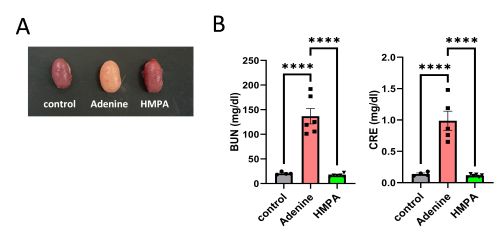
A, Left: normal mouse kidney. The kidneys of mice fed an adenine diet show abnormalities in appearance, such as whitening (center), but when HMPA is also fed, the kidneys appear normal (right).
B, Left is blood urea nitrogen (BUN), right is blood creatinine (CRE) concentration. Compared to normal mice, mice fed an adenine diet show higher levels (Adenine), but when given together with HMPA, each concentration shows normal values (HMPA)
Ponch picture
Glossary
(*1) Polyphenol
A general term for ingredients found in large quantities in plants. It is found in coffee, green tea, fruits, vegetables, etc., and its relationship with health has been studied.
(*2) HMPA
It is considered to be one of the active substances that exert the effects of polyphenols. It has been reported that many polyphenols, such as chlorogenic acid contained in coffee, hesperidin contained in citrus fruits such as mandarin oranges, ferulic acid contained in rice, etc., and curcumin contained in turmeric, are metabolized by intestinal bacteria to HMPA and absorbed into the body.
(*3) Adenine food
A special feed for experimental animals (mainly mice and rats) that contains a substance called adenine.
(*4) Metabolites of intestinal bacteria
It is a substance created by intestinal bacteria by decomposing and converting food components. Food ingredients can have important roles in the way they work in the body.
(*5) Functional food ingredients
It is an ingredient in food that is expected to play a role in maintaining health and preventing disease. This study shows that HMPA has the potential to be used as a functional food ingredient that protects the kidneys.
- Press release materials (530.25 KB)
- Publication journal (Scientific Reports)
- Hiroshima University Researcher Guidebook (Professor Noriyuki Yanaka)
Noriyuki Yanaka, Professor, Graduate School of Integrated Life Sciences
Tel: 082-424-7979 Fax: 082-424-7947
E-mail: yanaka*hiroshima-u.ac.jp
(Please replace * with half-width @)