Key points of this research result
- For NPIM derivatives, which are photodegradable protecting groups (a ``molecular lid'' that is removed by light, i.e., an optical cage), we have elucidated the reaction mechanism that efficiently releases active components by ``quantum spin manipulation'' that utilizes the lifetime of the excited state and the properties of electron spin.
- Upon light irradiation, the NPIM molecule transitions to the singlet excited state and then to the long-lived triplet excited state, which suppresses the two radicals generated afterwards from recombining back to the original singlet molecule due to spin rules. Unlike conventional methods, the key to molecular design is to use spin to suppress the "return reaction" after cleavage.
- Optical cages are used in cell function analysis, neuroscience, precision organic synthesis, materials processing, and more because they can initiate molecular functions at the location and time of light exposure without the need for additional reagents. If the quantum spin manipulation demonstrated in this study can be established as a design guideline, it may lead to the development of molecules that achieve high emission efficiency with a small amount of light, photoresponsive materials with less loss due to recombination, and drug delivery in living organisms.
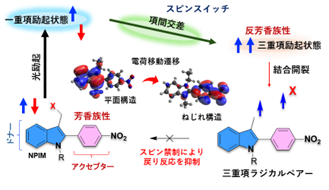
Schematic diagram of the dissociation reaction mechanism after photoexcitation of NPIM molecules elucidated in this study
概要
A research group led by Professor Manabu Abe of the Graduate School of Advanced Science and Engineering, Hiroshima University, and Professor Nobuyoshi 𠮷 of the Institute for Solid State Physics, the University of Tokyo, is researching the photodegradable protecting group 2-(4-nitrophenyl)-1.HWe have elucidated a reaction mechanism that efficiently releases active components through "quantum spin manipulation" that utilizes the lifetime of the excited state of -indole-3-ylmethyl (NPIM) derivatives and the properties of electron spin. Through analysis combining various spectroscopic measurements and theoretical calculations, we revealed that NPIM molecules form a twisted state within 5 picoseconds of light irradiation, transition to a triplet excited state (Note 1), and from there, "homolysis (Note 2)" occurs in which bonds are evenly broken. In addition, since the two radicals are generated as a triplet pair, recombination back to the original singlet ground state (Note 3) of the molecule becomes less likely to occur due to the spin selection rule (Note 4), leading to high emission efficiency.
本成果は、電子スピンを利用して「戻り反応」まで制御するという新たな分子設計指針を示すものであり、少ない光量で高効率に機能する光ケージ分子や光応答材料の開発、生体内で薬剤を精緻に放出するドラッグデリバリーなどに役立つことが期待されます。
本成果は、国際学術誌であるJournal of the American Chemical Societyに8月28日付け(米国東部夏時間)で掲載されました。
研究の背景
A photodegradable protective group (a ``molecular lid'' that can be removed by light = optical cage) is a molecular technology that temporarily blocks the action of drugs, biomolecules, etc., and releases active ingredients when exposed to light at a targeted location and time. Because molecular functions can be precisely controlled spatiotemporally using light without the need for additional reagents, it is used in a wide range of fields including cell function analysis, neuroscience, organic synthesis, and material processing.
On the other hand, in the case of optical cage molecules, in order to design optical cages that efficiently release active ingredients, it has been a challenge to understand the reaction of radicals generated after bond cleavage (after opening the molecule's lid).
Research content
In this study, we clarified the excited state and dissociation process of NPIM derivatives using various experimental methods and theoretical calculations (Figure 1).
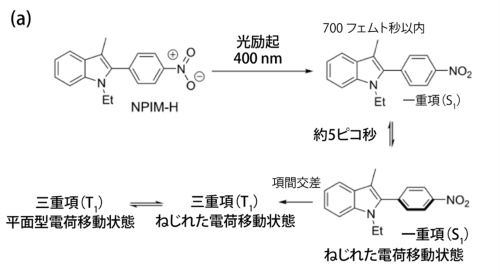
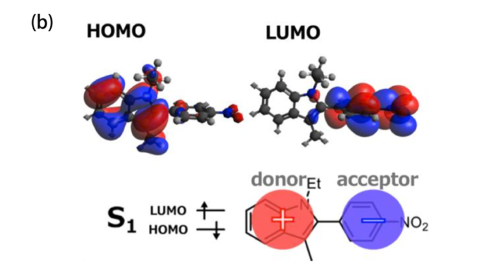
Figure 1: (a) Photoexcitation dynamics of the NPIM-H molecule revealed by ultrafast infrared vibrational spectroscopy, (b) Electronic state density of singlet excited states HOMO (Note 5) and LUMO (Note 6) by molecular orbital calculation
In this research, we confirmed that the NPIM molecule that absorbed light caused a charge transfer (Note 7) from the indole site (donor) to the nitrophenyl site (acceptor), and that both sites formed a twisted charge transfer state in about 5 picoseconds. Ultrafast infrared vibrational spectroscopy developed at the Institute for Solid State Physics at the University of Tokyo revealed that this twist reduces the energy difference between the singlet excited state (Note 3) and the triplet excited state, resulting in a transition to the triplet excited state in approximately 1 nanosecond.
Furthermore, we demonstrated that "homolysis" in which bonds are evenly broken from the long-lived triplet excited state progresses, generating radical pairs that maintain the triplet spin state, making recombination to the original singlet molecule less likely to occur due to spin selection rules. We have shown that the key to achieving highly efficient photoreactions is not only to promote bond cleavage as in the past, but also to control the return reaction after cleavage using spin. In addition, both experiments and theoretical calculations revealed that polar solvents significantly reduce bond cleavage efficiency, and showed that the elimination of triplet antiaromaticity (Note 8) is the driving force for the reaction.
A summary of the new discoveries is as follows.
• Reaction field mainly consisting of triplet:When the triplet is erased with oxygen, the decomposition rate is reduced by about 70% in air and by about 88% in oxygen atmosphere, indicating that bond cleavage mainly proceeds from the triplet excited state.
• Track reactions directly over time:Using various spectroscopy methods, we sequentially observed the singlet excited state (lifetime 1.6 ns), triplet excited state (2.3 μs), and NPIM radical intermediate (1.5 ms).
• Check the cutting pattern from the product:In situ infrared spectroscopy directly detected CO₂ derived from benzoic acid, oxidized NPIM products, and benzoyl radicals, supporting a radical-generating homolysis mechanism.
• Twisting promotes spin conversion:The energy difference between the singlet excited state and the triplet excited state is as small as 5.3 kcal/mol, and it was shown that the twisted charge transfer state reduces this difference and promotes intersystem crossing. Ultrafast infrared vibrational spectroscopy developed at the Institute for Solid State Physics at the University of Tokyo has revealed the dynamics involving twisted charge transfer states from sub-picoseconds to nanoseconds (Figure 2).
• Quantify solvent effects and driving forces:The bond cleavage efficiency from the triplet excited state was 0.82 for carbon tetrachloride and 0.56 for benzene, while it was 0.012 for acetonitrile. Calculations showed that polar solvents raise the barrier and that the elimination of triplet antiaromaticity favors cleavage.
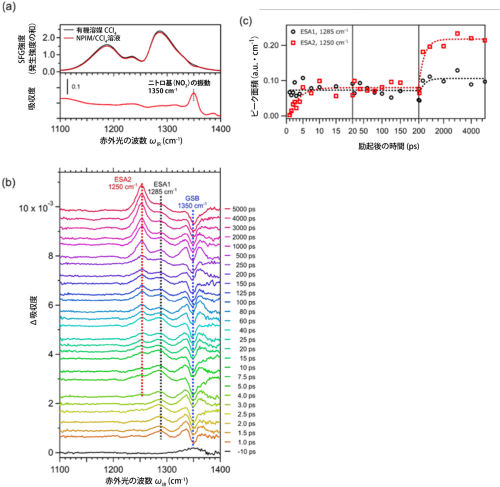
Figure 2: (a) Upconversion spectrum of mid-infrared probe pulse and steady-state infrared absorption spectrum of NPIM-H molecule. (b) Transient vibrational spectrum of NPIM after 400 nm photoexcitation. A peak indicating the twisted type (ESA2) appears from 5 picoseconds (red dotted line) (c) Temporal changes in the peak intensities of ESA1 (planar type) and ESA2 (twisted type).
Significance of this result and future prospects
This research demonstrated that "quantum spin manipulation" using electron spin plays an important role as a factor controlling the reaction efficiency of optically caged molecules. This demonstrated a new molecular design guideline for controlling not only bond cleavage but also the subsequent recombination reaction.
This result is expected to lead to the development of optical cage molecules that achieve high emission efficiency even with low amounts of light, and photoresponsive materials with less loss due to recombination. It is also expected to contribute to the advancement of drug delivery technology that releases drugs at the required location and timing within the body, as well as highly accurate light control technology. This mechanistic verification was mainly performed in 355-400 nm light and organic solvents. In addition, the reaction rate decreases in the presence of oxygen, and bond cleavage efficiency decreases significantly in polar solvents, so molecular design suitable for underwater and biological environments is a future challenge.
Presenter/researcher information
広島大学
Graduate School of Advanced Science and Engineering
Professor Manabu Abe
University of Tokyo
Condensed Matter Research Institute
Kenta Kuroishi Specially Appointed Researcher
Professor Jun Shinnobu
Ryusuke Matsunaga Associate Professor
Paper information
雑誌名:Journal of the American Chemical Society(online)
Title: Mechanistic Insights into Photo-Induced Bond Dissociation of A 2-(4-Nitrophenyl)-1H-indole-3-ylmethyl (NPIM) Derivative: A Case Study on Quantum Spin-Manipulation for Photo-uncaging
Author name: Kenta Kuroishi*, Ryuei Hayashi, Ryoko Oyama, Shunsuke Tanaka, Kotaro Ogawa, Yuta Murotani, Ryusuke Matsunaga, Jun Yoshinobu*, and Manabu Abe* (*Corresponding author)
DOI: 10.1021/jacs.6c13942
URL: https://doi.org/10.1021/jacs.6c13942
research grants
This research was supported by Grants-in-Aid for Scientific Research (20H00343, 22K19033, 26H00891) and JST-CREST (JPMJCR18R4, JPMJCR20R4).
Terminology explanation
(注1)三重項励起状態
Among the electronic states of a molecule, the state in which the total spin quantum number is (S=1) and the spin multiplicity (2S+1) is 3 is called the triplet state. The typical lowest energy triplet excited state (T1) has one electron in each HOMO and LUMO, and is characterized by the fact that the spin directions of the two electrons are the same. Compared to the singlet excited state, relaxation to the electronic ground state is less likely to occur, making it easier for photolysis reactions to proceed.
(Note 2) Homolysis
One of the ways in which molecular bonds are broken. The reaction in which the two electrons of the shared electron pair responsible for the bond are separated one by one to form two radicals is called homolysis. On the other hand, the reaction in which two electrons of a shared electron pair move to one side to form an ion pair is called heterolysis.
(Note 3) Singlet ground state, singlet excited state
Among the electronic states of a molecule, the state in which the total spin quantum number is (S=0) and the spin multiplicity (2S+1) is 1 is called a singlet state. The electronic ground state of most organic molecules is the singlet state, which transitions to the singlet excited state by absorbing light. The typical lowest energy singlet excited state (S1) has one electron in each HOMO and LUMO, and is characterized by the fact that the spin directions of the two electrons are opposite. In the singlet excited state, the excitation energy is relatively quickly converted to light or heat and relaxed to the electronic ground state using the spin selection measurement shown below.
(Note 4) Spin selection rule
A quantum mechanical constraint that prohibits transitions between electronic states with different spin multiplicities. S1状態から基底状態への遷移はスピン多重度が変化しないため許容遷移である一方で、T1状態から基底状態への遷移はスピン多重度の変化を伴うため禁制遷移となります。その結果T1The state can remain in its excited state for a long time and photolysis reactions can proceed.
(注5)HOMO
Among the single-electron orbitals occupied by electrons in the electronic ground state, this is the molecular orbital with the highest energy.
(Note 6) LUMO
電子基底状態で電子が占有されていない一電子軌道のうち、エネルギーが最も低い分子軌道です。
(注7)電荷移動
A transition from the ground state to the excited state in which the position of the electron changes significantly is called a charge transfer transition. Since the NPIM used in this study has significantly different distributions of HOMO and LUMO, S1やT1States have charge transfer properties.
(Note 8) Triplet antiaromaticity
In the electronic ground state of a planar cyclic molecule, when the number of π electrons spread along the ring is 4n+2, the molecule is stabilized by the electrons spreading throughout the ring, and this property is called aromaticity. On the other hand, when the number of π electrons is 4n, the molecule becomes unstable, and this property is called antiaromaticity. In the triplet excited state, this relationship is reversed, with 4n π electrons exhibiting aromaticity, and 4n+2 π electrons exhibiting antiaromaticity. The latter is called triplet antiaromaticity.
- Press release materials (986.7 KB)
- 論文掲載ジャーナル (Journal of the American Chemical Society)
- 広島大学研究者ガイドブック (安倍 学 教授)
(Please contact the presenter regarding the research content)
Hiroshima University Graduate School of Advanced Science and Engineering
Professor Manabu Abe
Tel: 082-424-7432 E-mail: mabe*hiroshima-u.ac.jp
東京大学 物性研究所
教授 𠮷信 淳(よしのぶ じゅん)
Tel: 04-7135-3320 E-mail: junyoshi*issp.u-tokyo.ac.jp
University of Tokyo Institute for Solid State Physics Public Relations Office
Tel: 04-7136-3207 E-mail: press*issp.u-tokyo.ac.jp
Hiroshima University Public Relations Group
Tel: 082-424-4518 E-mail: koho*office.hiroshima-u.ac.jp
(Please replace * with half-width @)