研究者情報
Researcher name
Tomoya Hanaoka
Researcher name
下村 通誉
研究者名
Takahiro Sugiyama
概要
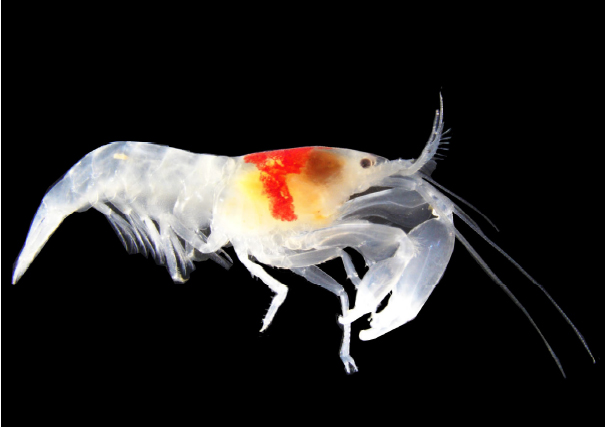
Tomoya Hanaoka, master's student, Graduate School of Science, Kyoto University, Ryutaro Goto, assistant professor, Field Science Education and Research Center, Kyoto University, Michiyo Shimomura, professor, Sugiyama High School, doctoral student (at the time), Graduate School of Science, Kyoto University, Isao Hirabayashi, technical staff member, Tohoku University, Keiichi Nomura, former director of Kushimoto Marine Park, Yuki Iya A research group led by Kochi University professors has rediscovered the purple shrimp, a type of long-eared shrimp that has been suggested to live in the burrows and body surfaces dug by caterpillars and feed on their mucus, in the intertidal zone of southern Wakayama Prefecture, about 45 years after it was first described as a new species. This discovery was made in the intertidal zone, where research has been more advanced than in the deep sea, making it a rare discovery compared to other living creatures.
Genetic analysis has also revealed that the purple shrimp extensively uses four species of leaf insects in two genera belonging to at least the genus Acrobatus and the genus Vulgaricum. The results of this research can be said to be an important discovery from the perspective of conservation ecology, in that they have revealed the symbiotic ecology of the purple shrimp, which had been overlooked until now. The results of this research were published in the international academic journal "Zoological Science" on August 5, 2026.
Researcher's comments
``At first glance, it may seem like a simple task to prove that ``the discovery of the purple shrimp was made for the first time in 45 years,'' or ``this is the first time that it was revealed that it uses a certain caterpillar,'' but in reality, what is written in past documents is correct. It requires a complicated process of comparing the results of fieldwork with information from specimens, etc. I hope that readers will also focus on another aspect of natural history research, which is how to place the results obtained through fieldwork in relation to past records.'' (Tomoya Hanaoka)
"We have discovered yet another thing about the biodiversity of the intertidal zone, where the symbiotic system of waterworms thrives. Because of its Japanese name, Murasaki Ebimodoki, you may imagine that it has a purple body color, but it is actually a bright red-and-white species. It is very cute to see the small shrimp running around on the body surface of the waterworms." (Ryutaro Goto)
Source: https://www.kyoto-u.ac.jp/ja/research-news/2026-09-07