How can music help us recover from stress?
A new study by Chinese scientists suggests the answer may lie in how music unfolds over time. Instead of merely distracting us from a stressful experience, music appears to engage the brain's stress-regulation system through changes in musical tension—the changing sense of anticipation and release that arises from the way music as a whole unfolds over time.
Compared with calming, water-based natural sounds, music produced a distinct reorganization of communication between auditory regions and key stress-related areas, including the insula and thalamus. These changes were associated with improved positive mood and faster physiological recovery from acute stress.
The study, led by Prof. DU Yi from the Institute of Psychology of the Chinese Academy of Sciences, was published online in PNAS on September 8.
Acute stress triggers coordinated changes in the brain and body, including increases in heart rate, autonomic arousal, and cortisol. While music is widely used for relaxation, it has remained unclear whether its benefits go beyond those of other pleasant sounds, when these benefits are most apparent, and which brain mechanisms are involved.
To address these questions, the researchers conducted two experiments with a total of 120 healthy young adults. In the first experiment, participants listened to either relaxing music or natural sounds before or after completing a stressful mental arithmetic task.
Listening to music before the task did not significantly reduce the initial stress response. However, the effects of music became more apparent during the recovery period after exposure to the stressor. During this phase, music was associated with greater improvements in positive mood and faster recovery across several physiological measures.
In the second experiment, another group of participants underwent functional magnetic resonance imaging while recovering from the same type of stress. The results found that music altered communication between the auditory cortex and the insula and thalamus, brain regions involved in processing sound, monitoring bodily states, detecting important signals, and regulating arousal.
These changes followed a distinct pattern as participants recovered from stress. Early in the recovery period, dynamic causal modeling showed increased effective connectivity from the auditory cortex to the insula, indicating stronger directional influence of auditory regions on the insula. Later, communication between the insula and thalamus increased, and this change was associated with greater improvement in positive mood.
Importantly, as perceived musical tension rose and fell over time, connectivity among these brain regions also changed. These connectivity patterns were, in turn, associated with recovery in mood, heart rate, and autonomic balance.
"Music is a highly structured signal that unfolds through cycles of anticipation, tension, and resolution," said Prof. DU. "Our findings suggest that the brain may use this evolving structure as a scaffold to reorganize its stress-regulation networks, helping both the mind and body return to a more balanced state."
The results suggest that musical tension may be an important factor in understanding how temporal structure contributes to stress recovery. These findings also provide a potential neural framework for investigating how music-based interventions could be designed to support stress resilience in everyday life and clinical care.
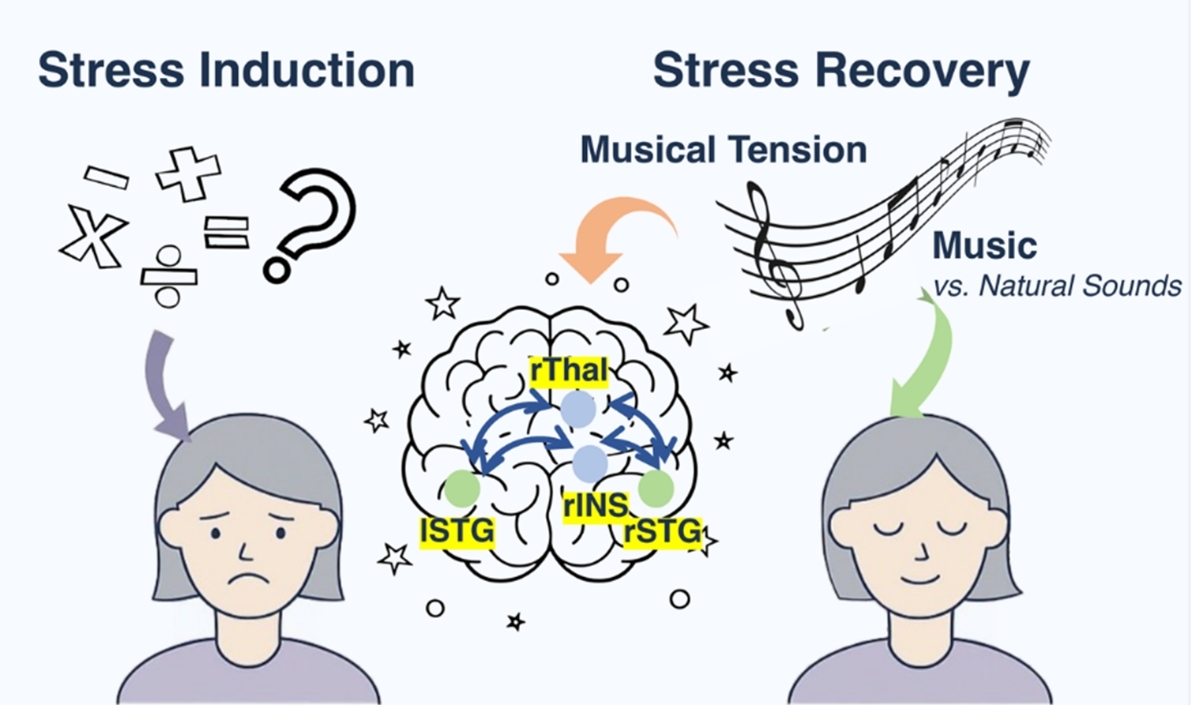
How music reorganizes the brain to bounce back from stress. (Image by YOU Siqi)
Source: https://english.cas.cn/newsroom/research-news/202609/t20260907_1192713.shtml