Early Investment in an Emerging Scientist
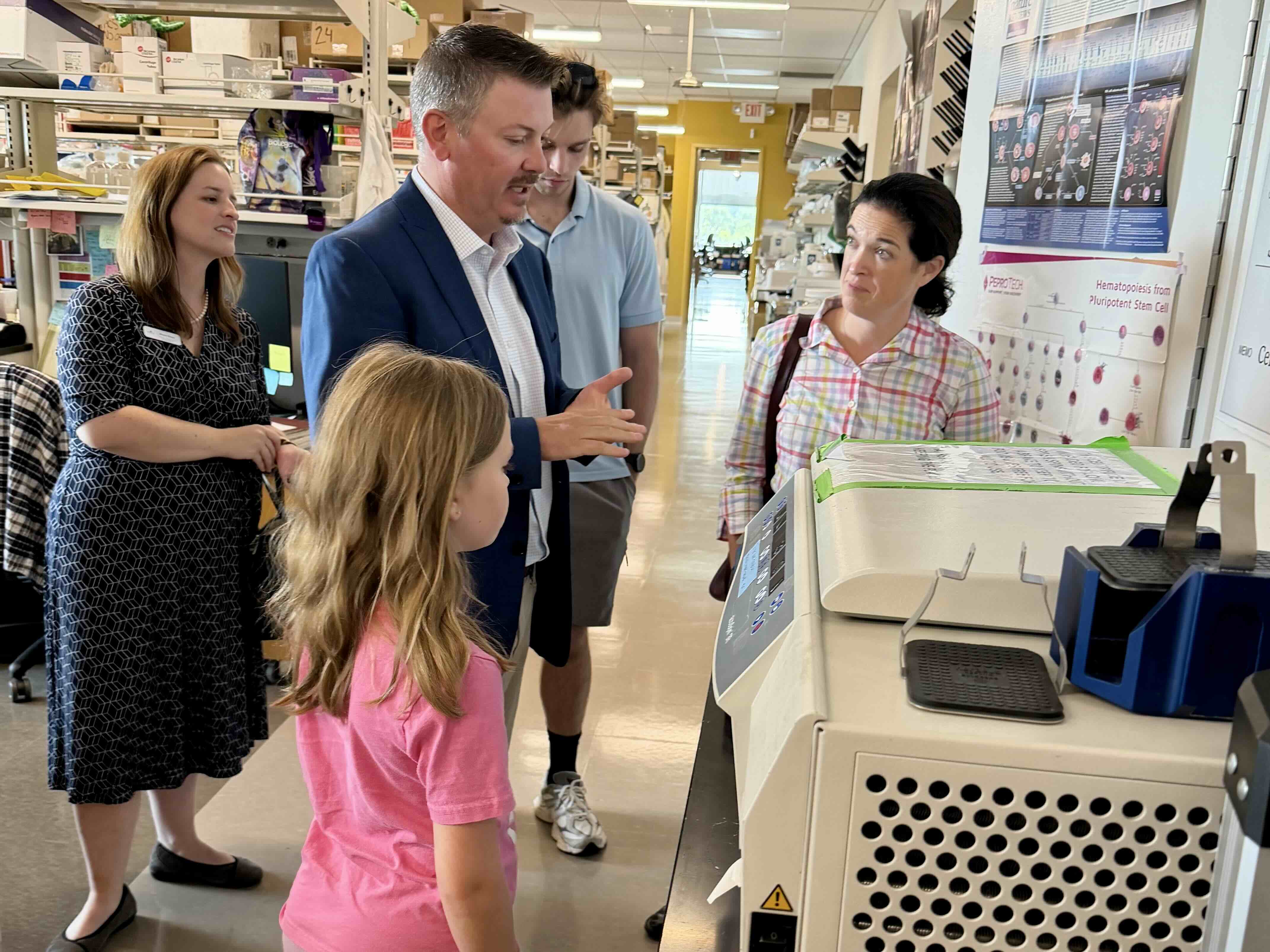
The Children’s Cancer Research Fund (CCRF) recently visited the Center for Genome Engineering at the University of Minnesota.
During their visit, CCRF guests toured our research spaces and met with scientists working to harness the power of genome engineering and the immune system to better understand, prevent and treat cancer. They also learned more about the people and ideas behind the research, including the work of Drs. Branden Moriarity and Beau Webber.
One of the most meaningful takeaways from the visit was seeing the ripple effect of investment in science.
The first grant Dr. Beau Webber ever received was a $100,000 grant from CCRF’s Emerging Scientist seed funding.
Webber states, "Seed grants like the emerging scientist award have allowed us to pursue innovative, outside-the-box ideas that may never had been possible with traditional funding sources."
Also, a guest reflected after the tour, “it was powerful to see how those early investments helped Dr. Moriarity and Dr. Webber leverage additional funding from the NIH and other sources.”
For researchers at the beginning of their careers, seed funding can provide the opportunity to test an innovative idea, generate critical preliminary data and take the next step toward discoveries that could ultimately benefit patients. That is the power of investing in science early.
Continuing the Relationship
We are especially grateful that CCRF is continuing to invest in innovative cancer research at the University of Minnesota. This year, CCRF awarded $270,000 to support two exciting projects at the Center for Genome Engineering.
Dr. Branden Moriarity received funding for research exploring in vivo gene therapy to prevent cancers that can develop after bone marrow transplantation in patients with Fanconi anemia. Dr. Joseph Skeate also received funding to advance next-generation CAR-driven therapies for malignant peripheral nerve sheath tumors, with a focus on engineered gamma-delta T cells and pediatric cancer.
These projects represent different approaches to cancer research, but they share something important: bold ideas, talented scientists and the potential to open new paths toward better treatments.
What are they working on now?
Dr. Moriarity shared a perspective that brought the research into focus.
He explained that our bodies are remarkably good at detecting and eliminating abnormal cells before they ever become clinically detectable cancer. In fact, many of us have likely had cells in our bodies that could have become cancer, but our immune systems recognized and eliminated them.
That simple idea is at the heart of much of the work happening at the Center for Genome Engineering: Can we better understand the body's natural defenses and learn how to harness its own immune cells to fight cancer?
We were able to share with the group exciting new research behind Un-TIL It’s Cured, our effort to develop next-generation tumor-infiltrating lymphocyte (TIL) therapy. By combining the power of the immune system with genome engineering, our researchers are working toward CRISPR-edited TIL therapies that could give more patients access to a powerful, personalized approach to cancer treatment.
We are grateful to CCRF and their donors for believing in our scientists, supporting innovative ideas and helping create the conditions for discoveries that can reach patients. Sometimes, a breakthrough starts with a seed. And sometimes, you can see the ripple effect years later.
Source: https://med.umn.edu/cge/news/seed-funding-breakthroughs-ccrf-visits-center-genome-engineering