Key points of this research result
- Discovery of numerous "gene switches" that promote growth in Western honeybees: CAGE (Cap Analysis of Gene Expression) method to analyze the starting point of gene expression1was applied to identify 842 enhancers that act during the metamorphosis stage (larva to pupa) of the Western honey bee.2We identified 17,349 transcription start sites (TSSs) as candidates.
- Elucidating the mechanism that drives key genes important for metamorphosis:tram track(ttk) is an essential transcription factor for insect metamorphosis.Broad-complex(Br-c) and other genes.
- Suggesting a gene regulatory mechanism specific to the genus Honeybee:ttkAs a result of comparing the binding sequences of the genus Honeybee (ApisIt was found that it may be restricted to the genus).
overview
A research group led by researcher Kohei Tsuga and professor Hidemasa Bono of the Graduate School of Integrative Life Sciences, Hiroshima University, is working onApis melliferaの働きバチが幼虫から蛹へと成長する「変態」の過程で働く、遺伝子の調節領域「活性化エンハンサー」を特定しました。
Within the honeybee hive, there is a caste of queen bees who give birth to children and worker bees who are responsible for building the nest and raising children. These larvae have the same genetic information, but their roles differ depending on the environment in which they grow. To create such differences, a mechanism that activates the necessary genes at the right time is essential. One such mechanism is an "enhancer." Enhancers act like switches, regulating which genes are activated, when they are activated, and how much they are activated. However, in the Western honey bee, many of these functions have so far been limited to predictions based on sequences, and it has not been well understood how they actually work.
The research team used an analysis technique called the "CAGE method" to comprehensively investigate enhancers that are activated during the metamorphosis period of worker bees in Western honey bees. As a result, we succeeded in identifying enhancers that control genes important for insect metamorphosis and transcription factors that bind to these enhancers.
Paper information
Magazine name: Insects
Title: Genome-Wide Identification of Transcriptional Start Sites and Candidate Enhancers Regulating Worker Metamorphosis inApis mellifera
Author: Kouhei Toga, Kakeru Yokoi and Hidemasa Bono,*
DOI: https://doi.org/10.3390/insects17050516
background
Theoretically, it was predicted that the evolution of the highly social nature seen in the Western honey bee would require flexible regulation of gene expression networks. In fact, progress has been made in decoding the genomes of bees, including the Western honey bee, and it has been found that there is a correlation between the number of transcription factor binding sites that bind to enhancers and the complexity of sociality (from solitary to highly social). However, there is a lack of quantitative activity evidence regarding which enhancers actually act at which times. Although there are several methods for elucidating enhancer activity, the CAGE method has not been used to capture enhancer activity in Western honeybees.
Therefore, the research team focused on the metamorphosis process of worker bees and attempted to measure enhancer activity using the CAGE method. This is because during the metamorphosis process, organs are reorganized from the larval form to the adult form, and gene expression is actively regulated. Therefore, the metamorphosis process from larva to adult is considered to be an excellent model for studying transcriptional regulation in the Western honey bee. Since the CAGE method can quantitatively measure transcription start sites, it is also possible to predict gene expression controlled by enhancers.
In this study, we aimed to use this method to visualize the relationship between enhancer activity and gene expression, which controls successive developmental stages from larva to pupa.
Contents of research results
- Understanding the complete picture of transcriptional activity during the metamorphosis stage of worker bees
CAGE was performed at each stage of the larva (days 9 and 11), prepupa (day 15), and pupa (days 19 and 21), and 17,349 transcription start sites and 842 enhancer candidates were identified. Many enhancers are located in intronic regions within genes, suggesting that they contribute to tissue-specific expression. - Capturing gene expression changes related to metamorphosis
When we clustered the expression profiles obtained from CAGE data, we obtained five clusters of expression patterns. In each cluster, we found that the expression of genes predicted to be associated with metamorphosis, such as cuticle development, lipid metabolism, neurotransmission, muscle development, and low-molecule metabolism (glucose metabolism, etc.), was found to be altered. In addition, it is well known that it is expressed during the metamorphosis process of insects.Broad-complex(Br-c)4orE93In this study, we were also able to confirm that the expression of this protein was changed. These results show that the obtained CAGE data reflects the metamorphosis process of worker bees, supporting the validity of this method. - transcription factortram track(ttk) Identification of genes controlled by
Enhancers present in the peripheral regions of genes revealed above, their activities, and transcription factor binding sequences that bind to enhancers3I looked into the types. As a result, we were able to predict 15 sets of correspondence relationships between enhancers, transcription factors, and target genes. Among them, transcription factorsttkis the key gene for metamorphosisBr-cWe found that it may bind to the enhancer and regulate its expression (Figure 1). - Evidence for lineage-specific evolution
identifiedttkComparing the nucleotide sequences of the binding site with those of other bees, we found that the genus Apis, to which the Western honey bee belongs (Apisonly within the genusttkThe binding site was conserved (Figure 1). This suggests that honeybees may have developed their own metamorphosis control mechanism, but experimental support is needed in the future.
Future developments
By experimentally verifying the functions of the enhancer regions and genes identified in this study, we will be able to clarify the overall picture of gene expression regulation that controls worker bee growth. In terms of applications, targeting these enhancers and modifying their base sequences using genome editing technology may lead to the imparting of traits useful in beekeeping. The social significance of this research is significant, as worker bees act as pollinators in the ecosystem and are essential for the production of strawberries and other agricultural products that require pollination, as well as for maintaining biodiversity.
Reference materials
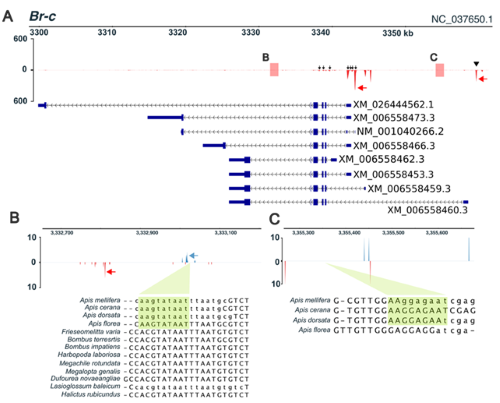
Figure 1.tram track(ttk) Enhancer region containing the binding site. The CAGE method can detect RNAs with different orientations, and enhancer regions can be quantitatively identified as regions where bidirectionally transcribed RNAs exist at positions separated by several hundred base pairs or more. In all panels, red (red arrows) and blue peaks (blue arrows) indicate signals on the negative and positive strands, respectively. The green box indicates the predictedttkThe binding site (derived from the Drosophila melanogaster motif) is shown. Genetic models are shown in blue. Corresponding enhancer regions in other bee species are displayed at the bottom of each panel. Base sequences in lowercase letters represent repeat regions in the genome. The vertical axis represents count data of transcription start points calculated by the CAGE method. (A)Br-cgene structure and transcription start site. Arrowheads and arrows indicate each transcription start site. Red boxes represent enhancer regions identified in this study, and regions B and C are enlarged in panels (B, C). (B)Br-cIntronic enhancer region within (enlarged view of region B in panel (A)). (C)Br-cAdditional intronic enhancer regions within (enlarged view of region C in panel (A)). The figure is from Toga et al. (2025)Insects, Partially modified from the figure from https://doi.org/10.3390/insects17050516 under CC BY 4.0 license.
Glossary
- Enhancer: A genomic region that has the function of increasing the amount of gene expression.
- CAGE method (Cap Analysis of Gene Expression): A method to read the sequence by selectively capturing the 5' end (cap structure) of RNA. Transcribed RNA has a landmark called a cap structure, a structure that can be seen not only at the transcription start site of a gene, but also in trace amounts of RNA transcribed from enhancers (enhancer RNA).
- Transcription factor binding sequence: Proteins called transcription factors bind to enhancer regions, regulating the expression level of surrounding genes and the tissues in which they are expressed. Which transcription factors bind can be predicted based on the type of sequence, and in this study, predictions were made based on the binding sequences of Drosophila melanogaster.
- Broad-complex(Br-c): A gene encoding a transcription factor that controls the transition from larva to pupa during insect metamorphosis. It is widely known that it is essential for the progression of metamorphosis.
- Press release materials (778.1 KB)
- Article publication journal (Insects)
- Hiroshima University Researcher Guidebook (Professor Hidemasa Bono)
Professor Hidemasa Bono, Graduate School of Integrated Life Sciences
Tel: 082-424-4013
E-mail: bonohu*hiroshima-u.ac.jp
(Please replace * with half-width @)