PET can observe human metabolism and molecular activities and plays an important role in tumor diagnosis and efficacy evaluation. Recently, the Shenzhen Institute of Advanced Technology of the Chinese Academy of Sciences and others have made progress in the field of low-count PET imaging.
The research team proposed a new AI model framework of "counting-aware diffusion and gated autoregressive inference". This model can refer to existing structural and contrast information, gradually reduce noise, restore details, and make the generated PET image more stably close to the standard counting reference.
The study included a total of whole-body PET/CT data from four hospitals, and constructed different degrees of low-count PET through different acquisition durations. The results show that for low-count images collected in 3 seconds, the model can significantly reduce noise, improve image clarity and quantitative accuracy. In tests conducted in three independent centers in Shandong, Zhuhai and Wuhan, this method also performed stably under different collection durations, showing a certain adaptability across hospitals and data distribution.
Relevant research results were published inMedical Image Analysis上。研究工作得到国家自然科学基金、国家重点研发计划和中国科学院科研仪器设备研制项目等的支持。
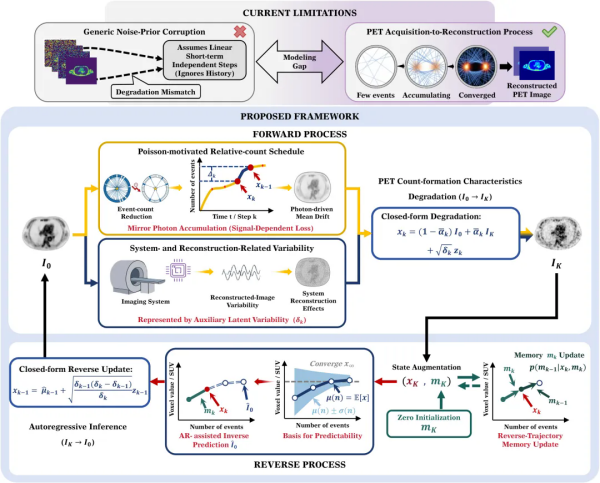
Count-aware diffusion and gated autoregressive inference framework
Source: https://www.cas.cn/syky/202608/t20260828_5119221.shtml