本研究成果のポイント
- We cultivated a microorganism called Thraustochytrid [1] using the seasoning waste liquid produced when making pickles such as Hiroshima greens, and confirmed that it was possible to produce cultured products containing docosahexaenoic acid (DHA) and eicosapentaenoic acid (EPA) [2], which are useful for maintaining human health.
- When raising Thraustochytrids, we found that there is no need to sterilize the pickle seasoning waste liquid [3] and that the pickle seasoning waste liquid can be used repeatedly. It has also been found that repeated use of cooking waste makes it difficult for thraustochytlids to grow due to the accumulation of lactic acid, leading to a decrease in the production of DHA and EPA.
- 生産したDHA、EPAを含む培養産物は、将来的にDHA・EPAを多く含む鶏卵や養殖魚の生産に利用できることが期待されます。
概要
A research group led by Professor Satoshi Nakai of the Graduate School of Advanced Science and Engineering at Hiroshima University has demonstrated that DHA and EPA can be produced using the seasoning waste liquid produced when making pickles such as Hiroshima greens.
漬物の調味廃液は、DHAやEPAは、健康維持に役立つ成分として食品やサプリメントなどに利用されています。現在、その主な原料は魚油ですが、将来的な需要の増加を考えると、魚に頼らない新たな生産方法が求められています。
The research group focused on a microorganism called Thraustochytlid that can produce DHA and EPA. When this microorganism was grown using waste liquid from seasonings from pickles such as Hiroshima greens, it was confirmed that DHA and EPA could be produced without sterilizing the waste liquid. It was also found that DHA and EPA can be produced even if the seasoning waste liquid from Hiroshima greens is used repeatedly.
On the other hand, when seasoning waste liquid was repeatedly used, microbial growth and DHA/EPA production decreased. We revealed for the first time that one of the reasons for this is that lactic acid that accumulates in wastewater inhibits the growth of Thraustochytrids.
This result demonstrates the possibility of effectively using pickle seasoning waste liquid, which has been difficult to reuse, as a resource for producing DHA and EPA. In the future, it is expected that it will be used in the production of chicken eggs and cultured fish that contain high amounts of DHA and EPA.
本研究成果は、2026年7月17日(金)(日本時間)にElsevier社の学術誌「LWT」にオンライン掲載されました。
Paper information
・Paper title: “Repeated use of liquid pickle seasoning waste for the cultivation of Aurantiochytrium sp. in sustainable production of polyunsaturated fatty acids”
・著者:Anh Thi Nhat Tran, Satoshi Nakai, Toshikazu Suenaga, Takehiko Gotoh, Akira Umehara, Wataru Nishijima, Radita Putradhitama Novanda
・Published magazine: LWT
・Volume: 254
・Number: 119753
・DOI:10.1016/j.lwt.2026.119753.
background
DHAやEPAなどの多価不飽和脂肪酸はヒトの健康維持に有用な物質であり、DHA・EPAサプリメントやDHA・EPA強化鶏卵など、DHAやEPAを含む機能性表示食品の需要が増加しています。また、海産魚の成育にはDHAやEPAが必要であり、養殖魚の飼料にも利用されています。DHAやEPAの主な原料は魚油ですが、これら多価不飽和脂肪酸の今後の需要の増大を鑑みれば、漁獲に依存する魚油の生産は持続的ではありません。
Therefore, Professor Satoshi Nakai of the Hiroshima University Graduate School of Advanced Science and Engineering focused on the microorganism Thraustochytrid, which produces DHA and EPA. These microorganisms prefer salty environments and grow by decomposing organic matter. On the other hand, pickle seasoning waste liquid contains a lot of organic matter but is highly salty, making it difficult to reuse. Therefore, we began research on a ``carbon cycle [4] scenario'' (Figure 1) in which pickled food waste is used as a substrate (feed) for thraustochytrids, and the resulting culture products are used as a source of DHA and EPA for chickens and marine fish.
Contents of research results
Originally, the pickle seasoning waste liquid was acidic, but by adjusting it to a neutral pH of 7, we temporarily suppressed the growth of common microorganisms that had become accustomed to acidity, and the result was that one of the thraustochytrids.Aurantiochytriumsp. L3W was inoculated and cultured. As a result, as shown in Table 1, we were able to obtain biomass (culture product) containing DHA and EPA, although it was not as good as when using an artificial medium. In particular, biomass obtained from seasoning waste liquid from Hiroshima greens and pickled plums had reached a level that could be used to increase the DHA content of chicken eggs. Furthermore, the values for the cultured product also included co-contaminant microorganisms such as yeast, which is thought to be one of the reasons why the DHA and EPA contents were lower than when using an artificial medium. In addition, when cherry radish seasoning waste liquid was used, the DHA and EPA contents as well as the production of cultured products were low, but one of the reasons for this was thought to be the strong influence of coexisting microorganisms other than the L3W strain. When we actually compared the composition of fatty acids, we found that, unlike the others, the contribution of oleic acid was greater in cherry radish (Figure 2)
Next, the culture product was separated by centrifugation from the Hiroshima mustard seasoning waste liquid used for culturing the L3W strain, and the supernatant was adjusted to pH 7 and used repeatedly for culturing the L3W strain. Table 2 also includes the amount of proliferation (cell number) and the concentration of lactic acid in the waste liquid at the start of culture. Even after repeated use, proliferation of the L3W strain and production of DHA and EPA were confirmed. However, these levels decreased with reuse, and by the second reuse, they were at a level that made it difficult to use them as a source of DHA and EPA. At this time, the lactic acid concentration increased from 0.75 to 2.4 to 2.7 mg/L.
Therefore, in order to investigate the cause of the decrease in proliferation, we added lactic acid to the artificial medium and checked its inhibitory effect. As a result, as shown in Figure 3, even when the lactic acid concentration was 0.75 mg/L, the proliferation amount of L3W was 92%, and when the lactic acid concentration increased to 2.4 and 2.7 mg/L, it was confirmed that the proliferation amount decreased to 40% and 36%. From this, we confirmed that the accumulation of lactic acid can inhibit the growth of L3W strain when reusing seasoning waste liquid. However, the decrease in the amount of growth from the first to the second reuse (Table 2) cannot be explained by the inhibitory effect of the increase in lactic acid concentration shown in Figure 3, and it was assumed that the effect of the lack of substrates (L3W food) that are easy for the L3W strain to use was especially evident during the second reuse. There has never been a study that confirmed the effect of lactic acid on suppressing the growth of thraustochytrids, and this report is the first such study.
Future developments
The biomass of the L3W strain obtained from pickle seasoning waste liquid can be used not only as a source of DHA and EPA for chicken eggs, but also as a source of DHA and EPA in aquaculture. In the future, we would like to evaluate the possibility of using it as a source of DHA and EPA for farmed fish.
Reference materials
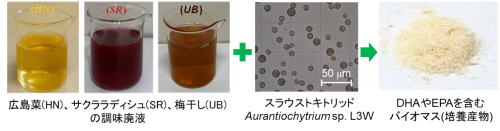
Figure 1 DHA/EPA production from pickle seasoning waste liquid through carbon circulation
Table 1 Amount of biomass (culture product) produced by culturing L3W strain using each pickle seasoning waste liquid, and its DHA and EPA content
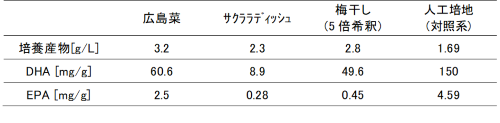
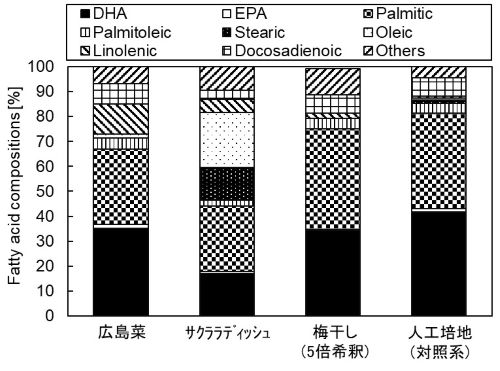
Figure 2 Comparison of fatty acid composition of biomass produced using each seasoning waste liquid
Table 2 Growth rate of L3W strain, biomass (culture product) production amount, DHA and EPA content, and lactic acid concentration in the waste liquid before culturing L3W strain in culture of L3W strain using Hiroshima pickle seasoning waste liquid repeatedly
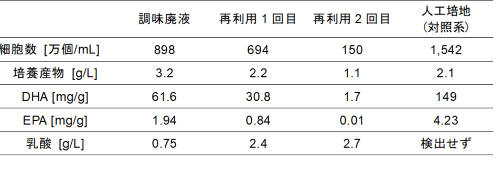
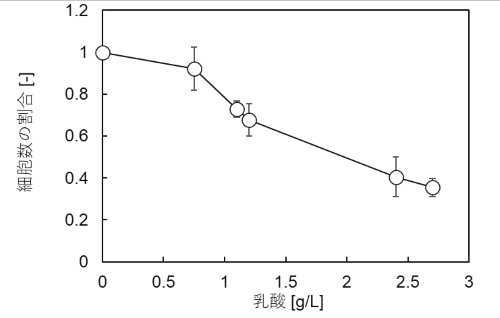
Figure 3 Changes in the growth rate of the L3W strain due to lactic acid (1 on the vertical axis is the growth rate of the L3W strain when lactic acid is not added, and the decrease in growth rate as the lactic acid concentration increases is expressed as a relative value)
Terminology explanation
[1] Thraustochytrid
It is a halophilic microorganism that grows using organic matter and produces polyunsaturated fatty acids such as DHA and EPA.
[2]DHA・EPA
A type of fatty acid that is found in large quantities in fish and other foods. It is used in supplements and foods with functional claims as an ingredient that helps maintain human health.
[3] Sterilization
A process that kills and removes microorganisms such as bacteria. In this study, we confirmed that thraustochytrids can be cultured without sterilizing pickle seasoning waste liquid.
[4] Carbon cycle
Rather than discarding carbon-containing materials, use them as another resource and recycle them. This research envisions a cycle in which the organic matter contained in pickle seasoning waste is used as a nutrient source for microorganisms, converted into a cultured product containing DHA and EPA, and used for eggs, farmed fish, etc.
others
This research was supported by JSPS Scientific Research Grants (23K25034, 25K03297) and JST eASIA (JPMJSC21E8).
- Press release materials (800.99 KB)
- Publication journal (LWT)
- Hiroshima University Researcher Guidebook (Professor Satoshi Nakai)
Satoshi Nakai, Professor, Graduate School of Advanced Science and Engineering
Tel: 082-424-7621
E-mail:sn4247621*hiroshima-u.ac.jp
(*は半角@に置き換えてください)