Cilia/flagella are "antenna-like" conserved organelles protruding from the cell surface and are widely found in various cells from single-cell eukaryotes to mammals. Among them, the moving cilia need to swing synchronously like a paddle to promote directional swimming of cells and complete physiological processes such as respiratory mucus removal and cerebrospinal fluid circulation by generating directional fluid flow. Once this "synchrony" is broken, it may lead to primary ciliary dyskinesia (PCD), left-right visceral inversion, hydrocephalus and other ciliary-related diseases. There is still a lack of mature treatment options. However, it has long been unclear what signals multiple cilia rely on to achieve coordinated swings.
中国科学院水生生物研究所科研团队长期以具有两根等长鞭毛的单细胞莱茵衣藻为经典模型,解析纤毛协调运动的分子机制。近日,团队找到了串联氧化还原与钙两条经典信号通路的关键“开关”——进化上保守的血红素结合轴丝蛋白CYB5D1。
研究发现,CYB5D1依赖58号位天冬氨酸结合或释放血红素,动态调控鞭毛内的氧化还原电位,并以此“门控”钙信号的时空模式。氧化信号可诱导两根鞭毛出现耦合式同步的Ca2+spikes,使协调摆动的细胞比例维持在84%以上。还原信号则会打破这一同步,协调性骤降至约15%。而CYB5D1缺失或其血红素结合能力受损时,鞭毛陷入“过度还原”状态,cis-鞭毛的Ca2+spike频率与幅度异常升高,两根鞭毛随之失去同步。
该研究在活体鞭毛中将氧化还原状态与钙信号的动态变化纳入同一研究框架,明确了二者在纤毛运动调控中的直接分子联系,并揭示了细胞如何借助“氧化还原—钙”跨信号对话切换两根鞭毛力学主导权的新机制。这为理解纤毛协调运动的核心机制提供了新视角,也为PCD等纤毛疾病的机制解析与治疗干预开辟了新方向。
相关研究成果发表在《美国国家科学院院刊》(PNAS)上。
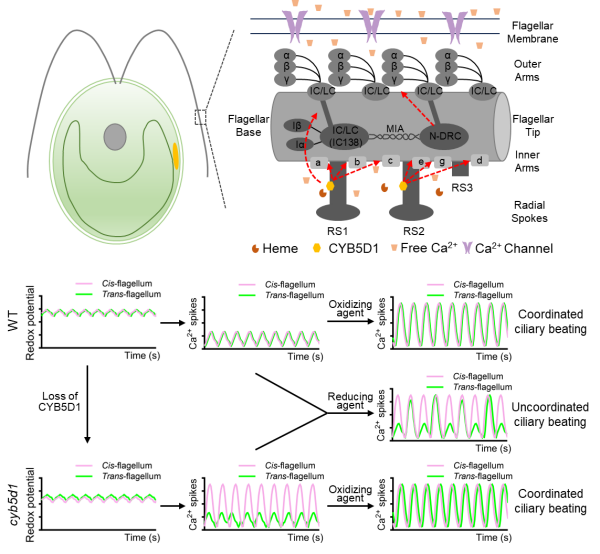
氧化还原信号通过耦合钙信号调控鞭毛协调摆动
Source: https://www.cas.cn/syky/202608/t20260824_5118845.shtml