SNU Professor Taesup Moon’s Team Reveals How Generative AI Is Eroding the Development Pathway for Software Developers
- What is disappearing is not only junior developers’ “jobs,” but also the “pathway” through which they grow into senior developers
- In-depth interviews with 14 junior and senior developers in Korea reveal four structural changes
- Study accepted to AIES 2026, an international conference on the ethical and societal impacts of AI
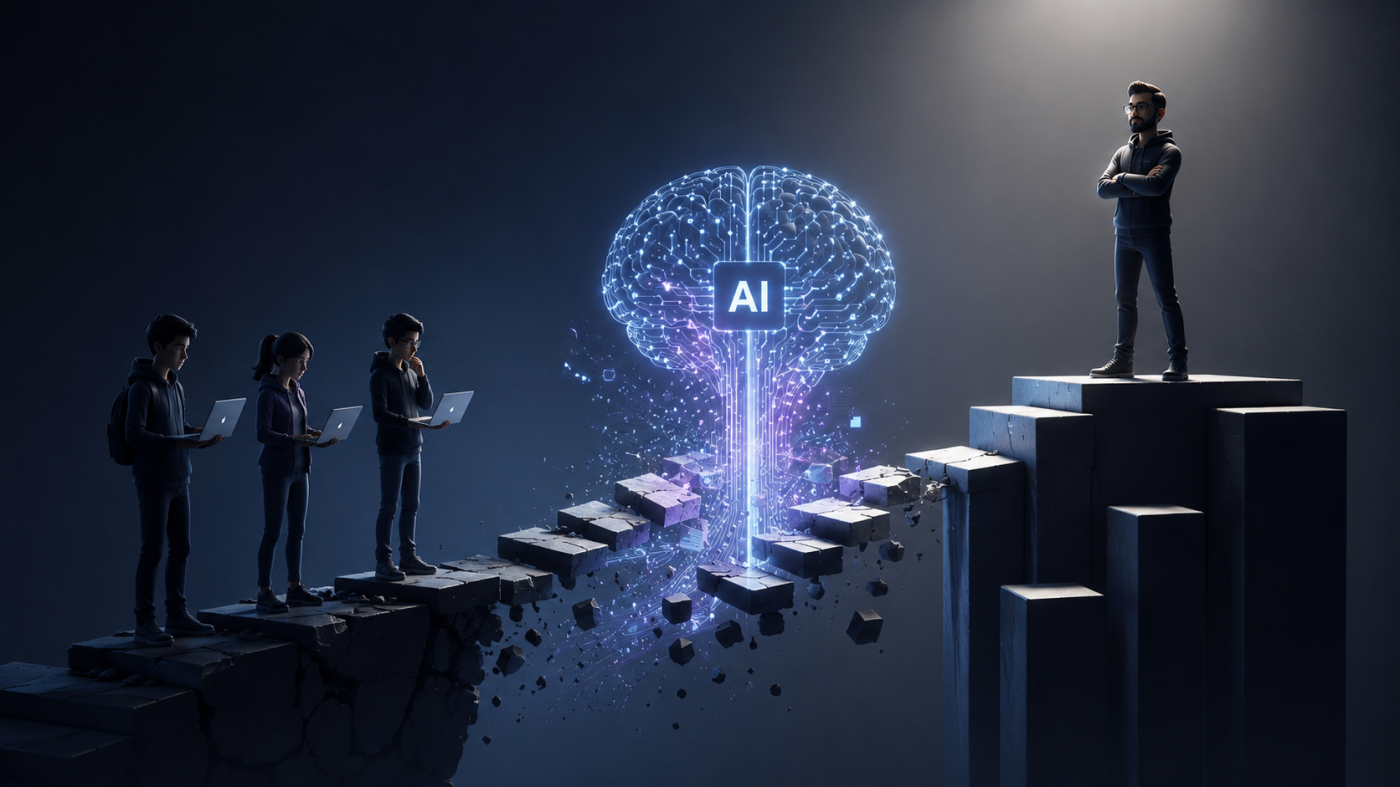
▲ Conceptual image illustrating the impact of generative AI on the development pathway of junior software developers
New research suggests that generative artificial intelligence (AI) could weaken not only employment opportunities for junior software developers, but also the pathway through which they develop into senior professionals.
A research team led by Professor Taesup Moon of the Department of Electrical and Computer Engineering at Seoul National University College of Engineering has investigated how generative AI is reshaping the development pathway of software developers. Through in-depth interviews, the researchers found that as AI takes over tasks traditionally performed by junior developers, it is also reducing opportunities for the hands-on experience and trial and error needed to develop into skilled professionals.
The paper presenting the findings, “Who Will Become the Next Senior? How Generative AI Erodes the Development Pathway in Software Engineering,” has been accepted to the 2026 AAAI/ACM Conference on AI, Ethics, and Society (AIES 2026), an international conference addressing the ethical and societal impacts of AI.
Generative AI is increasing productivity across the software industry by rapidly performing repetitive development tasks such as coding, debugging, and documentation. However, the new study raises a question that has received relatively little attention amid the focus on productivity gains: “If AI takes over junior developers’ work, where will the senior developers of the future come from?”
Hiring of entry-level developers has recently declined both in Korea and abroad. According to data cited in the paper, entry-level job postings at the 15 largest U.S. technology companies fell by 25% from 2023 to 2024. IT job postings in Korea declined by 43% over the same period, while positions targeting entry-level candidates accounted for just 4.4% of all job postings. However, it is difficult to attribute these declines solely to generative AI, as multiple factors—including post-pandemic workforce adjustments and the economic slowdown—have also played a role.
Rather than identifying the causes of declining recruitment, the study examined how the roles of junior developers and the process through which they develop professional expertise are actually changing following the widespread adoption of generative AI. While previous discussions have largely focused on “AI replacing jobs,” the researchers focused on the fact that the tasks being taken over by AI are not merely repetitive work, but have historically been part of the process through which developers build expertise by making mistakes and learning through trial and error. The researchers examined Korea as a case in which these changes are appearing in a relatively early and visible form: AI is involved in 51.8% of work-related activities there, nearly twice the U.S. figure, while conventional entry-level hiring has contracted sharply.
The research team conducted semi-structured interviews lasting approximately 50 minutes per participant with six senior developers currently working in the industry and eight junior participants preparing to enter software development careers. The senior participants were developers with at least six years of professional experience who had entered the workforce before the emergence of generative AI and remained employed, while the junior participants were undergraduates whose university years spanned both the periods before and after the emergence of generative AI. The researchers analyzed the interviews using reflexive thematic analysis and identified four major themes.
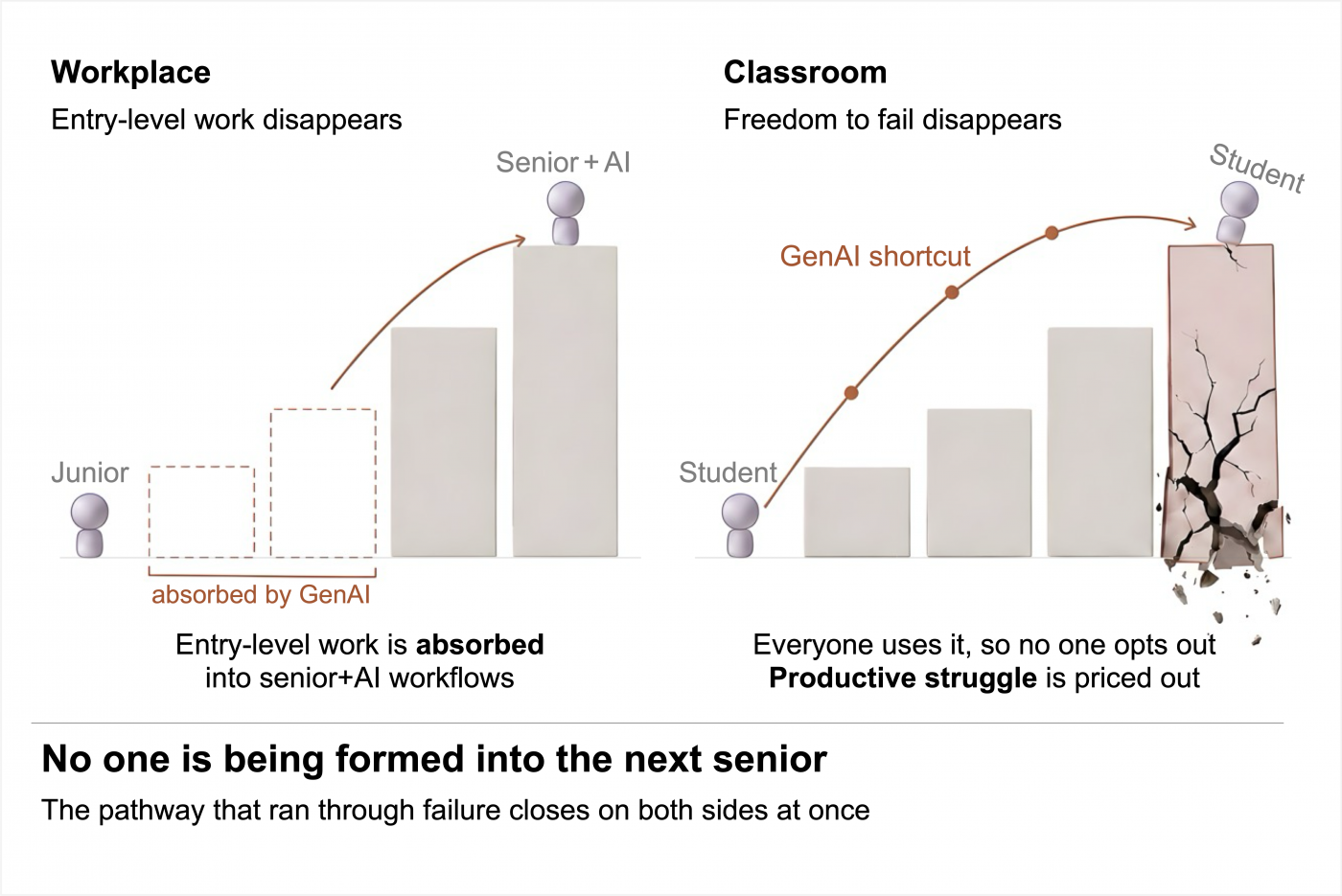
▲ Figure 1. Conceptual diagram showing how generative AI absorbs entry-level tasks and eliminates “opportunities to fail,” closing off the development pathway
The first theme was the shift of junior-level work toward a “senior + AI” workflows. Senior developers were increasingly using AI to directly handle tasks such as basic implementation, debugging, and documentation that had previously been assigned to junior developers, reducing opportunities for juniors to gain hands-on experience in the process. One startup founder interviewed for the study said that the company had substantially reduced its junior workforce without any measurable impact on productivity, asking, “What makes a junior developer better than a KRW 100,000-per-month AI subscription?”
The second theme was that what disappeared was not simply “work,” but “opportunity to fail.” The researchers describe this through the concept of “productive struggle.” When learners make mistakes and correct them themselves, they develop not only knowledge, but also the ability to recognize what they do not know and identify errors in the results they produce. Junior participants said that they could now achieve good results with less effort than before, but at the same time described the difficulty of “not knowing what I don’t know.”
One participant who took two courses in the same field received the same grade in both, yet said that one course left them with actual knowledge while the other left them only with “the ability to use AI.” The only difference was whether the assignments could be completed using AI. The researchers found that current educational assessment methods do not adequately capture this distinction. Senior developers raised the same concern. One participant said, “The reason you become a senior is that experience teaches you what not to do. Now juniors can no longer learn from bad examples.”
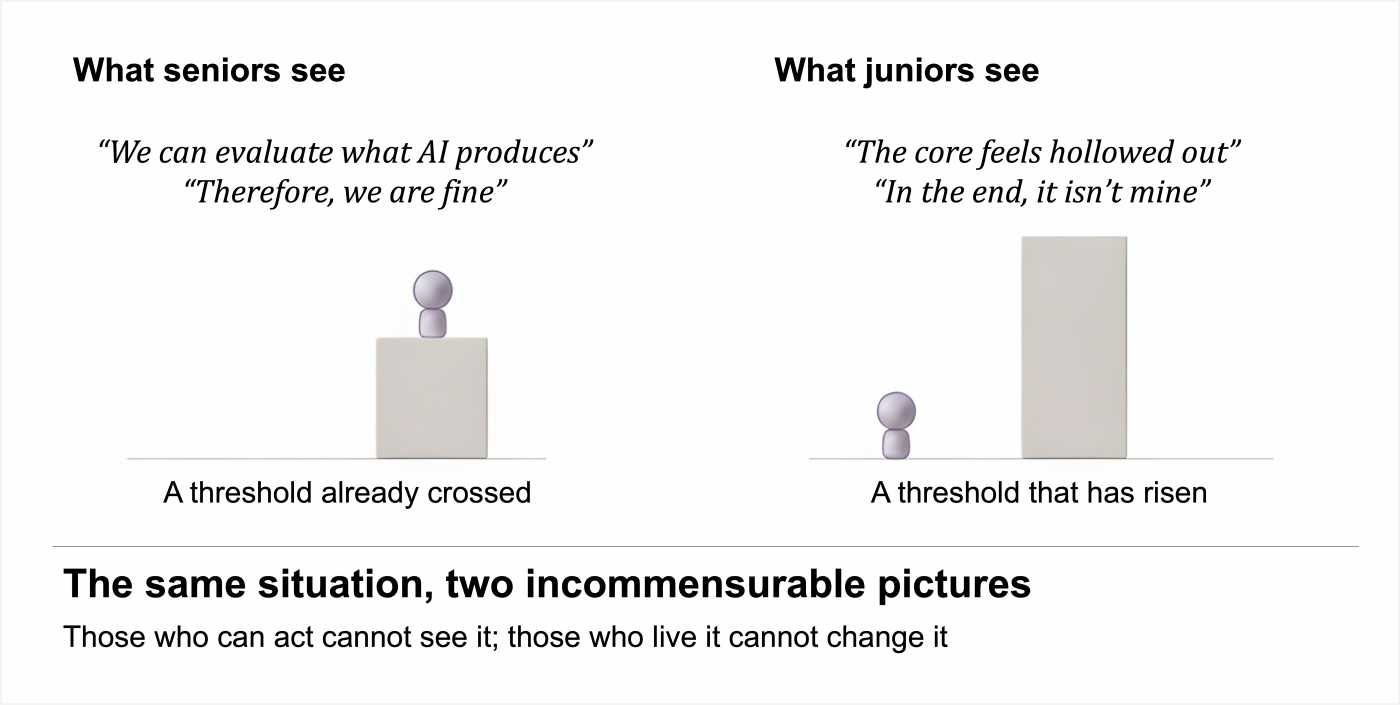
▲ Figure 2. Conceptual diagram illustrating how the mismatch between senior and junior perspectives prevents the problem from correcting itself
The third theme was that these changes are not simply the result of individual choices, but of structural pressure. When all of a student’s peers use generative AI, grading on a curve effectively becomes a mechanism that compels AI use. In the courses interview participants took, AI use was rarely restricted, so the loss of failure-based learning was structurally built into university classrooms as well, not just workplaces.
The fourth theme was that the problem does not correct itself because senior and junior developers perceive the same situation differently. Senior developers generally viewed the current changes as manageable because their years of practical experience enabled them to judge whether AI-generated results were correct or incorrect. Juniors, however, were losing precisely the opportunities for hands-on work and failure needed to develop those judgment criteria. One senior participant said, “We have 20 years of accumulated experience, so we can judge whether AI outputs are right or wrong. The next generation will not be able to reach that position. So we are fine.”
The research team explains this phenomenon through the theory of “situated cognition.” The problems people can perceive differ depending on the positions they occupy: senior developers and organizations with the power to address the issue may find it difficult to fully appreciate the circumstances facing juniors, while juniors who directly experience the problem lack the power to change educational and hiring structures. The researchers also found that the problem did not originate with generative AI alone. Senior developers themselves largely built expertise through hands-on work and trial and error rather than through formal training systems. In this sense, generative AI has not eliminated a newly created development pathway; rather, it has accelerated the erosion of a pathway that had not been institutionally protected in the first place.
The study provides evidence that the development pathway for software developers, which may be weakened by generative AI, should be institutionally protected rather than left to individual effort. Other high-risk fields already provide examples of institutional measures designed to compensate for the effects of automation on skill development. In aviation, pilots are advised to maintain opportunities for manual flying so that automation does not erode their manual flying skills (FAA SAFO 13002), while the nuclear industry requires regular simulator retraining to maintain operators’ response capabilities. These are examples of deliberately preserving experiences necessary for developing and maintaining expertise even when automation can perform the underlying tasks. The research team proposed that similar improvements are needed in software engineering across three areas: universities, hiring, and companies.
At universities, the researchers argue that courses in which AI cannot achieve the learning objectives on behalf of students should be designated as required courses, and that “reducing AI dependence” should be used as a criterion for evaluating educational quality.
In hiring, they propose evaluating not only candidates’ ability to use AI to produce results quickly, but also their ability to recognize gaps in their own knowledge and detect errors while working with AI.
Within companies, the researchers explain that learning opportunities should be deliberately created for entry-level developers—for example, by assigning them small modifications to actual products and allowing them to directly experience the entire process from commits and code review through deployment.
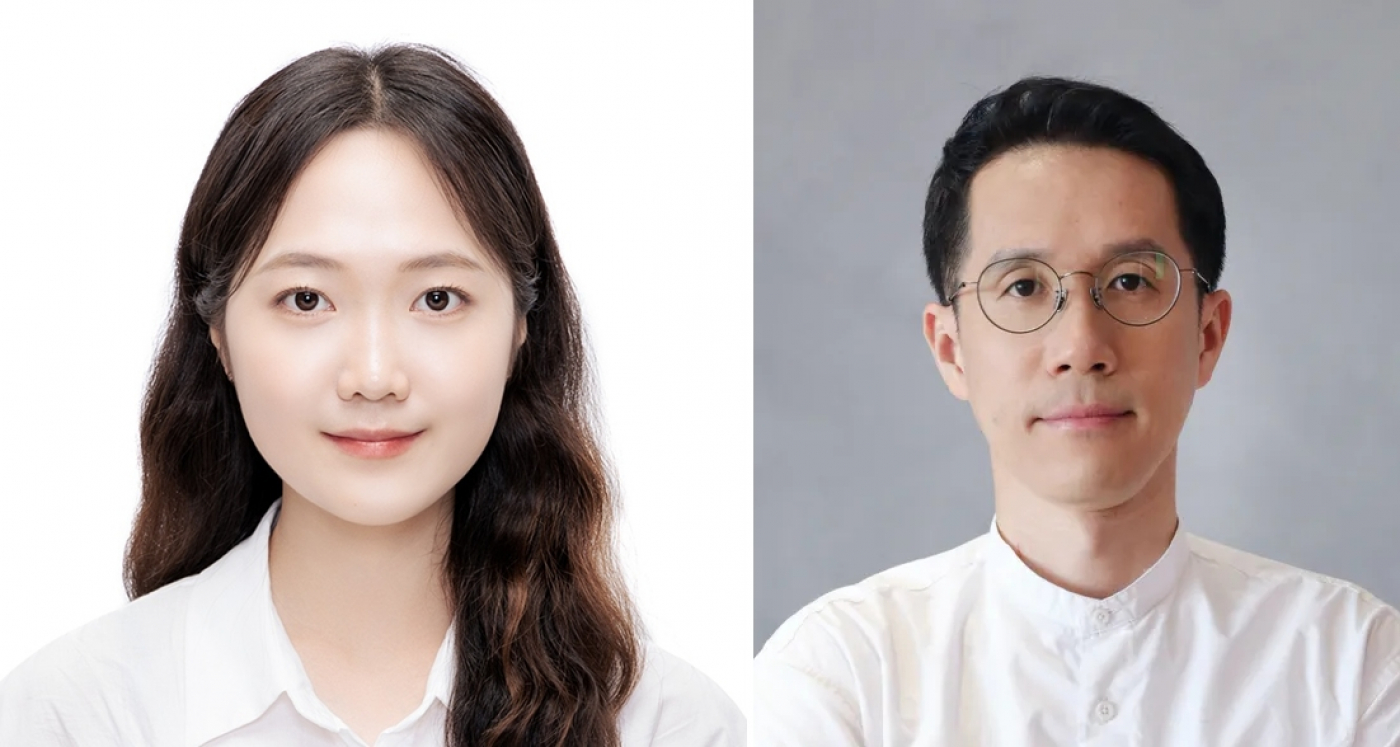
▲ From left: Sumin Yu, Ph.D. student in the Department of Electrical and Computer Engineering, and Professor Taesup Moon, Department of Electrical and Computer Engineering and Interdisciplinary Program in Artificial Intelligence, Seoul National University
Professor Taesup Moon, who supervised the research, said, “Some of the productivity we are gaining today may effectively be borrowed in advance from the expertise of the next generation. Because the cost is borne by a different group and at a different point in time from those making the decisions, it is structurally difficult to recognize. This study is significant because it empirically reveals that blind spot.”
He added, “Precisely because we are a department that develops AI technologies ourselves, I believe we have an even greater responsibility to ask what those technologies are doing to the development of the next generation. We plan to continue follow-up research focused on university education and to incorporate these findings into discussions on the design of our undergraduate curriculum.”
Sumin Yu, a Ph.D. student and the first author of the paper, conducts research on algorithmic fairness and bias, as well as AI governance, at the M.IN.D Lab in SNU’s Department of Electrical and Computer Engineering. In particular, she conducts empirical research on how generative AI affects human learning, decision-making, and social institutions, and plans to continue studying the interaction between AI technologies and society across a range of fields.
Meanwhile, AIES (AAAI/ACM Conference on AI, Ethics, and Society), where the paper has been accepted, is regarded alongside ACM FAccT as one of the two leading conferences in the field. Jointly organized by the Association for the Advancement of Artificial Intelligence (AAAI) and the Association for Computing Machinery (ACM), the ninth edition of the conference will be held in Malmö, Sweden, from October 12 to 14.
This research was supported by the National Research Foundation of Korea (NRF), the Institute of Information & Communications Technology Planning & Evaluation (IITP), and the BK21 FOUR Education and Research Program for Leading Future ICT Talent at Seoul National University.
[Reference Materials]
Title / Conference: Who Will Become the Next Senior? How Generative AI Erodes the Development Pathway in Software Engineering, AIES 2026
Original Paper: https://arxiv.org/abs/2607.17067
Paper Blog: https://sumin-yu.github.io/next-senior/
Lab: M.IN.D Lab, Department of Electrical and Computer Engineering, Seoul National University / https://mindlab-snu.notion.site/
[Contact Information]
Professor Taesup Moon, Department of Electrical and Computer Engineering
Seoul National University / +82-2-880-7297 / [email protected]
Source: https://eng.snu.ac.kr/en/research/research-achievements?md=v&bbsidx=8355