Recently, incountrydivisionstudyThe Hefei Institute of Physical Sciences has made progress in the research of high-performance molybdenum alloys. The research team designed solid-state reactions to use HfB2It reacts with the impurity oxygen in the molybdenum powder to form high-density, highly thermally stable and evenly distributed nano-Hf particles inside the molybdenum grains, which solves the problem of traditional dispersed particles easily agglomerating and coarsening, and achieves a synergistic improvement in the strength, plasticity and high-temperature stability of molybdenum alloys.
molybdenum(Mo) has the advantages of high melting point, good corrosion resistance and high thermal conductivity. In traditional dispersion-strengthened molybdenum alloys, the second phase particles are prone to coarsening in high-temperature service environments and aggregate at grain boundaries, causing stress concentration and seriously weakening the dispersion strengthening effect. This limits the improvement of the strength and toughness of traditional molybdenum alloys, resulting in insufficient thermal stability of their microstructure and restricting their engineering applications in high-temperature environments.
The research team designed an in-situ solid-state reaction strategy and introduced HfB into Mo-based powders.2As Hf source and control HfB during high temperature sintering process2Reacts with impurity oxygen to form high-density nano-Hf particles in situ within Mo crystal grains. The average size of Hf particles in the Mo-Hf alloy is about 54 nm, of which about 84% is evenly distributed inside the grains. High-resolution transmission electron microscopy results show that these nanoscale Hf nanoparticles exhibitface-centered cubestructure, and the Mo/Hf phase interface lattice mismatch is only 0.04%, and the interface energy is 1.28 J·m-2. Excellent lattice matching and low interface energy improve the stability of the phase interface, providing favorable conditions for the stable existence of Hf nanoparticles in the Mo matrix.
Microstructural analysis shows that Hf nanoparticles uniformly distributed within the crystal effectively hinderGot itDislocation slip promotes the storage, entanglement and interaction of dislocations inside the grains, thereby allowing the Mo-Hf alloy to maintain stable work hardening ability during deformation. Thanks to the unique intragranular nanodispersion structure, the tensile strength of Mo-Hf alloy reaches 754 MPa at 400 °C, and the total elongation is 22.5%. After annealing at 1000 °C for 100 h, the Hf particle size and number density remained stable; the annealed Mo-Hf alloy still maintained a tensile strength of 741 MPa and a total elongation of 24% at 400 °C, showing excellent high-temperature microstructure and mechanical property stability.
This study proposes a new strategy for constructing intragranular nanodispersed phases through in-situ solid-state reactions, providing new ideas for designing molybdenum alloys with high strength, good ductility and excellent thermal stability, and is of great significance to the development and application of high-performance molybdenum-based high-temperature structural materials.
Relevant research results were published in "Acta Materials" (Journal of Materials Science and Technology)Acta Materialia)superior. The research work is supported by the National Natural Science Foundation of China and the China Postdoctoral Science Foundation.
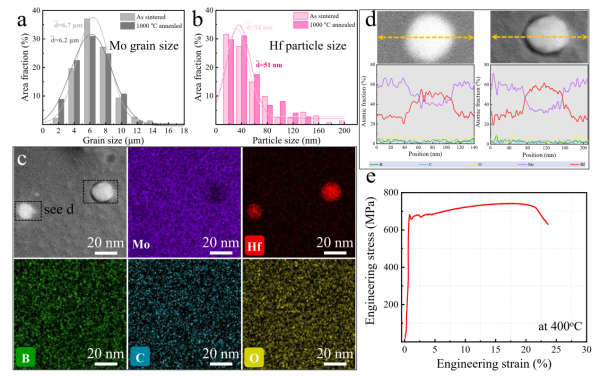
fAlloy Sutra1000℃annealing100 hoursThe final microstructure and400℃Tensile properties under
Source: https://www.cas.cn/syky/202608/t20260826_5119033.shtml