Researcher information
Researcher name
Takashi Sumikawa
Researcher name
Kota Sugisaka
概要
Professor Takashi Sumikawa, Graduate School of Energy Science, Kyoto University, PhD student Kota Sugisaka, Professor Yoshitaka Umeno, Institute of Industrial Science, University of Tokyo, Professor Hiroyuki Shima, Graduate School of Integrated Research, University of Yamanashi, Shigeyuki Arai, Institute for Future Materials and Systems, Nagoya University A research team led by a specially appointed associate professor carried out tensile compression fatigue tests on metal single crystals several hundred nanometers in size, and clarified the mechanism by which high fatigue resistance is achieved through dislocation depletion. Furthermore, based on this knowledge, we created a nanostructured metal metamaterial in which nanometer-sized holes are periodically provided in a metal single crystal, and demonstrated that it exhibits approximately twice the fatigue resistance of a homogeneous material while keeping the relative density approximately half that of a homogeneous material.
When a metal is subjected to repeated loads, regions (dislocations) with locally disordered atomic arrangement gather inside the crystal, forming a self-organized fatigue dislocation structure. This structure leads to the initiation of cracks that trigger fatigue failure. Furthermore, when holes are made in a material, force (stress) concentrates around the hole, making fatigue failure more likely to occur, so conventional material design generally avoids holes as much as possible.
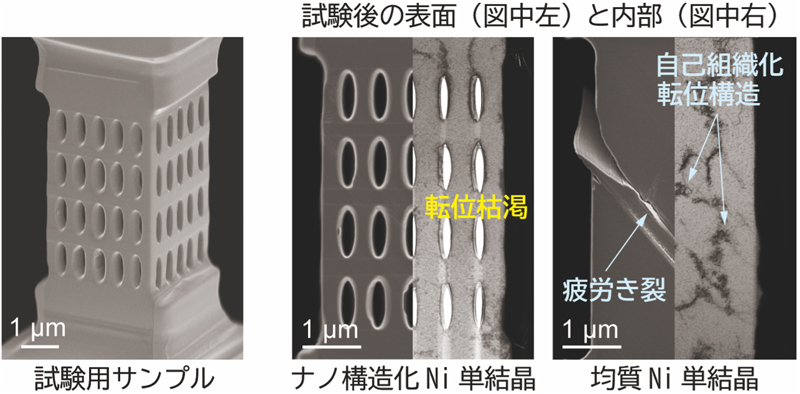
本研究では、金属単結晶中にナノメートル間隔で周期的に孔を配置すると、転位は孔の表面から生じる力学的作用によって材料の外へ放出され、内部の転位が枯渇することを明らかにしました。その結果、疲労破壊の発生につながる転位の自己組織化が抑えられ、軽量化と高い疲労耐性を両立できることを示しました。これまで強度上の弱点と考えられてきた孔を逆に積極的に利用するという、金属疲労における材料設計の常識を覆す成果であり、軽量で壊れにくい材料を実現するための新たな設計概念として幅広い応用が期待されます。
The results of this research were published online in the international academic journal "Advanced Materials" on August 23, 2026 (Central European Summer Time).
研究者のコメント
「強度設計の観点からは、『材料は寸法に寄らず同一の強度を有する』、『応力集中源となる形状は避ける』は長い歴史の中での常識でした。一方で、材料がナノスケールまで小さくなると、従来の常識が必ずしも成り立たなくなることが知られています。今回は『金属疲労』に着目し、材料にナノ構造を付与することで、軽量・高疲労耐性材料を実現する新しい設計概念を実証できました。本研究の成果は、『材料力学、材料強度学、金属疲労学』という学問にはまだまだ奥深さと広がりがあることを示しています。本研究をきっかけに、若い世代にもこれらの学問の面白さを感じてもらえればと思います。」(澄川貴志、杉坂浩太)
Source: https://www.kyoto-u.ac.jp/ja/research-news/2026-08-25-1