Researcher information
Researcher name
Satoshi Mashiko
Researcher name
Shinnosuke Honda
Researcher name
Shuntaro Ikeda
overview
A research group including Seishi Masuko, a doctoral student at Kyoto University's Graduate School of Agriculture, Assistant Professor Shinnosuke Honda, Professor Shuntaro Ikeda, and Specially Appointed Associate Professor Tomoyuki Tsukiyama of the Animal Life Science Research Center, Shiga University of Medical Science, is studying the key genes that allow mouse embryonic stem cells (hereinafter referred to as ES cells) to escape (break out of) a state that is close to "totipotency" after they temporarily reach a state close to "totipotency."Pcgf5I discovered this feature.
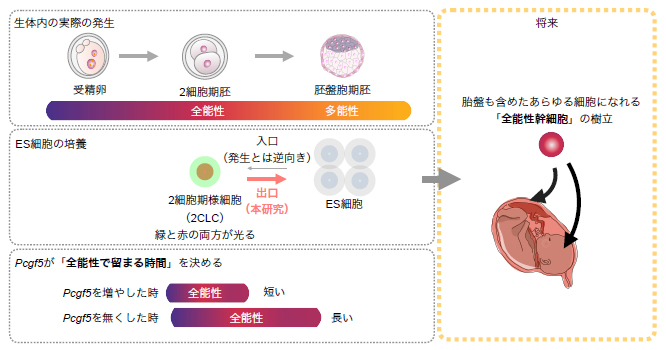
Our bodies begin with a single cell, a fertilized egg. A fertilized egg has a special ability called totipotency, which allows it to become any kind of cell, including the placenta, but this ability only lasts for a very short time and quickly moves on to the next stage. This "escape from totipotency" is an essential process for the normal development of life.
When mouse ES cells are cultured, it is known that a small portion (approximately 1%) of them temporarily transition to a state similar to a totipotent two-cell stage embryo immediately after fertilization, and are called "two-cell stage-like cells (hereinafter referred to as 2CLCs)." Much of the research to date has focused on the mechanism by which cells "enter" the 2CLC, but little is known about the mechanism by which cells "exit" from it.
This research group has created special ES cells that can tell whether the cells are in a totipotent state by the color of light.Pcgf5The amount of this gene was artificially increased or eliminated. the result,Pcgf5When increasing ES cells, the proportion of totipotent state decreases, and conversely,Pcgf5We found that the proportion of totipotent states increases when we eliminate . Furthermore, by using "time-lapse photography," which photographs cells one by one over four consecutive days,Pcgf5We directly confirmed that the ``length of time that ES cells remain in a totipotent state'' itself changes as the amount of ES cells increases or decreases.
These results indicate that it is possible to manually control the speed at which cells exit totipotency, and in the future, it is expected that this will lead to technology for stably culturing and maintaining cells in a totipotent state, and eventually to the establishment of new types of stem cells that can become any type of cell.
This research result will be published in an international academic journal on August 11, 2026.Biochemical and Biophysical Research CommunicationsPublished online.
Source: https://www.kyoto-u.ac.jp/ja/research-news/2026-08-27-0