研究者情報
Researcher name
武田 和行
Researcher name
Tomoya Kamide
Researcher name
Ayuto Tatsubo
overview
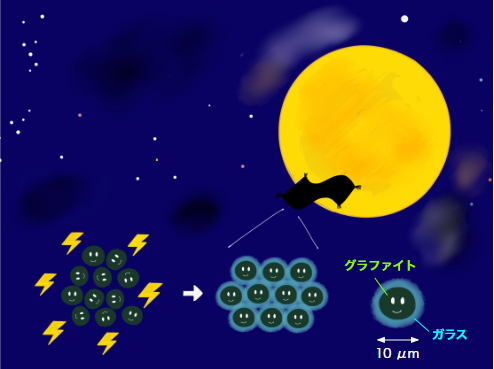
When you think of things that float in the air, you may think of imaginary things like magic carpets and castles in the sky. In fact, there are things like birds and drones that can float gently in the air without using any driving force. For example, the graphite used in pencil lead can be easily floated on a permanent magnet. The graphite pieces, which float silently in the air without any external drive and without touching anything, are expected to be applied to highly sensitive sensors that detect minute forces. To function as a sensor, graphite must be moved in a magnetic field, but a current flows through graphite, which conducts electricity well, putting a brake on its movement and reducing its performance. Therefore, there is a way to make graphite into fine particles and coat the surface with an insulator, making the whole material an insulator. However, the trade-off was that the high levitation force due to graphite's property called ``anisotropy'' was lost.
A research team including associate professor Kazuyuki Takeda, doctoral student Tomoya Kamide, and master's student Ayuki Tatsubo of the Graduate School of Science, Kyoto University, and professor Jason Twamley of the Quantum Machine Unit, Okinawa Institute of Science and Technology Graduate University, developed a hybrid magnetic levitation sensing material in which a thin glass layer is created on the surface of graphite particles to electrically insulate them, and the particles are aligned and solidified into a plate shape. This result is expected to be applied to next-generation highly sensitive measurement technology.
Researcher's comments
"It's just fun to watch small pieces of graphite levitate easily. Whereas with conventional levitators, the vibrations subside immediately, with the levitator made of the magnetically oriented surface-insulating graphite composite material, when you give it a little nudge, it vibrates. It was surprising to see it continue to vibrate for more than an hour.Although an earthquake that happened during the levitation experiment messed up the measurements, I am still positive, saying, ``We were able to successfully detect the earthquake.'' (Tomoya Kamide)
Source: https://www.kyoto-u.ac.jp/ja/research-news/2026-08-25-2